 FabricKnowledge Lab
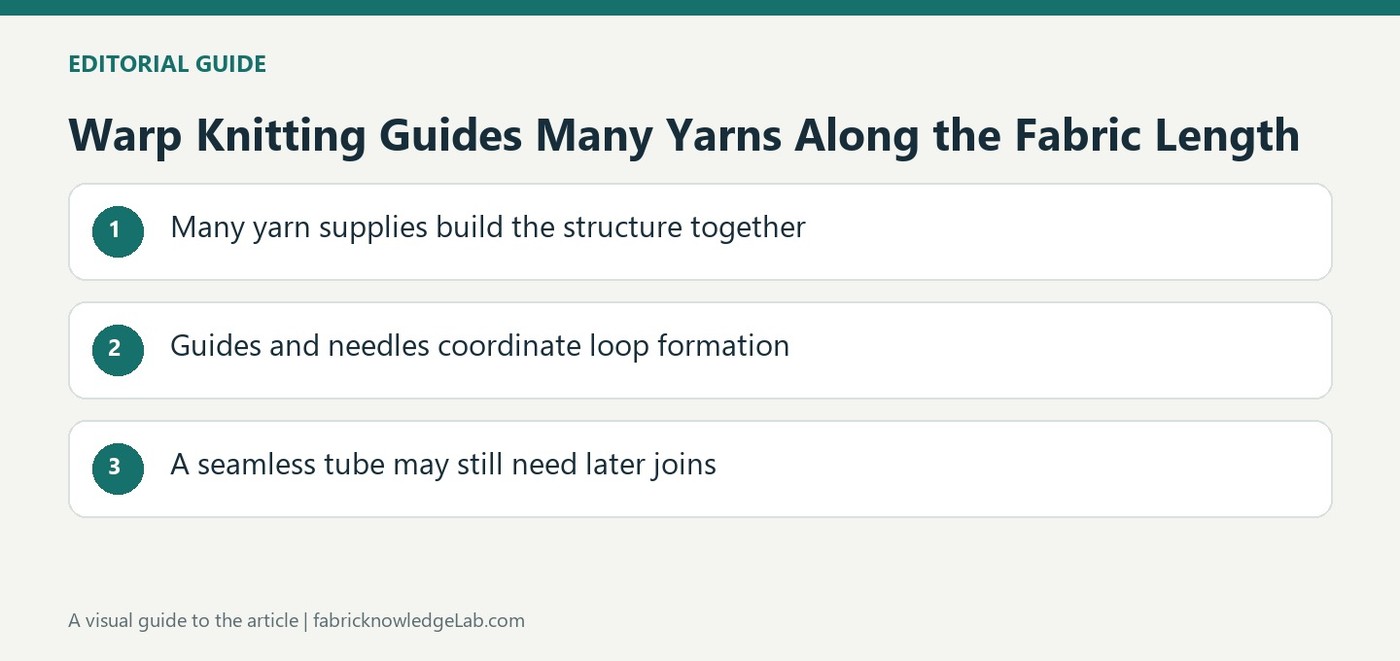
Many yarn supplies build the structure together
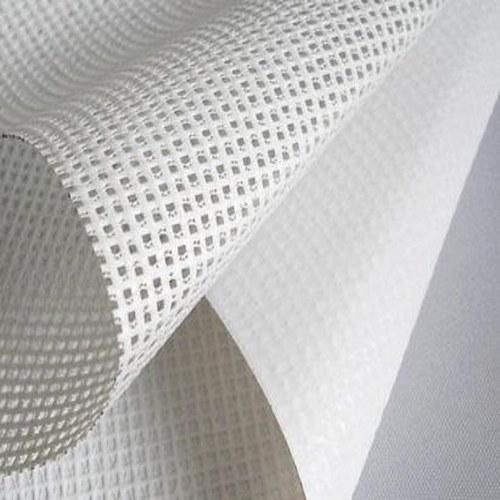
Woolmark describes warp knitting as a process in which multiple yarn threads are guided along the length of a fabric. The yarns move between needles to form interconnected columns and a zigzag arrangement of loops. This differs from a weft-knit course built across the width. The number and movement of the yarn supplies help explain why warp knitting is often associated with long production runs and a range of open or closed structures. The process name identifies how loops are formed, rather than one fiber composition, fabric weight, or finished garment style.
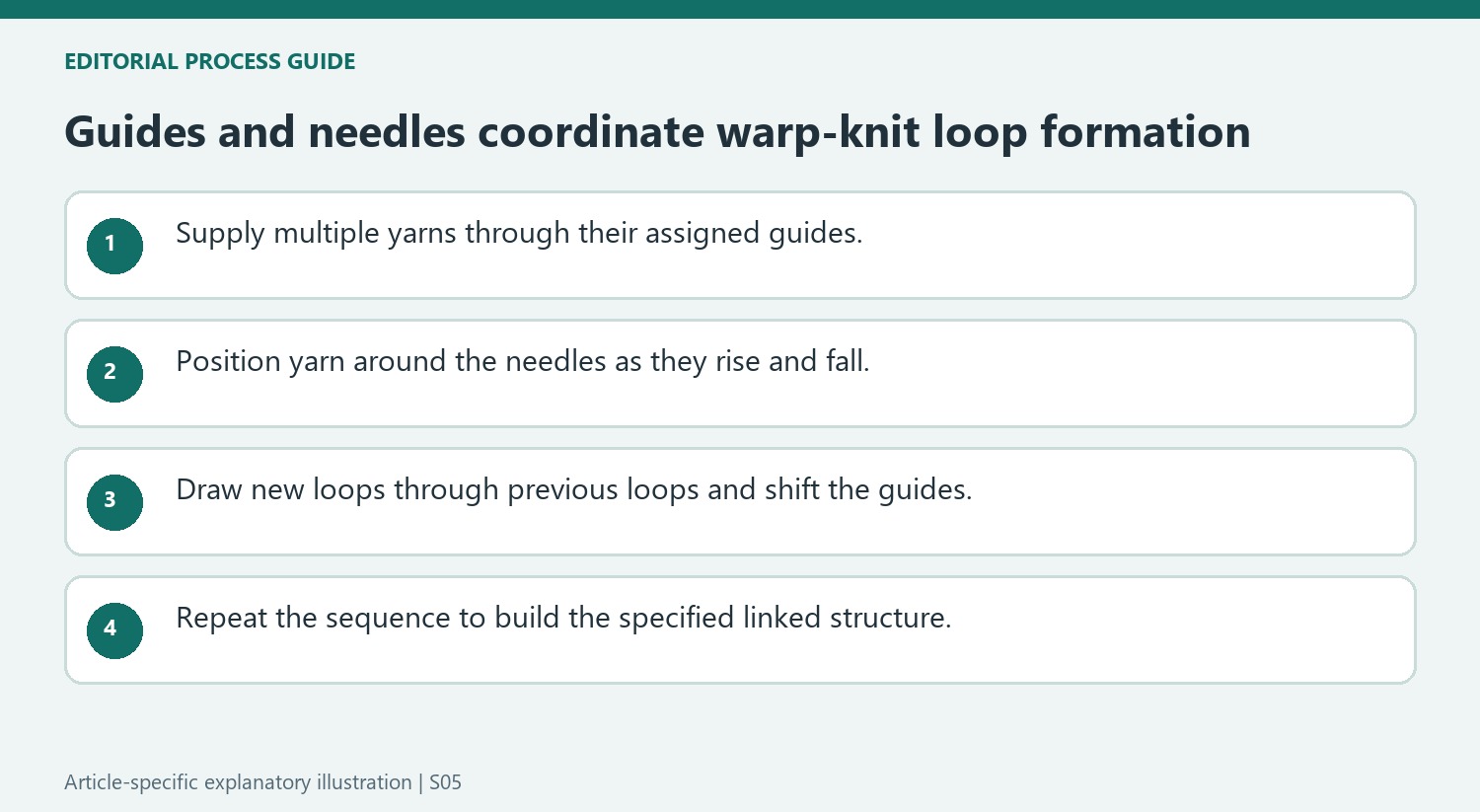
Guides and needles coordinate loop formation
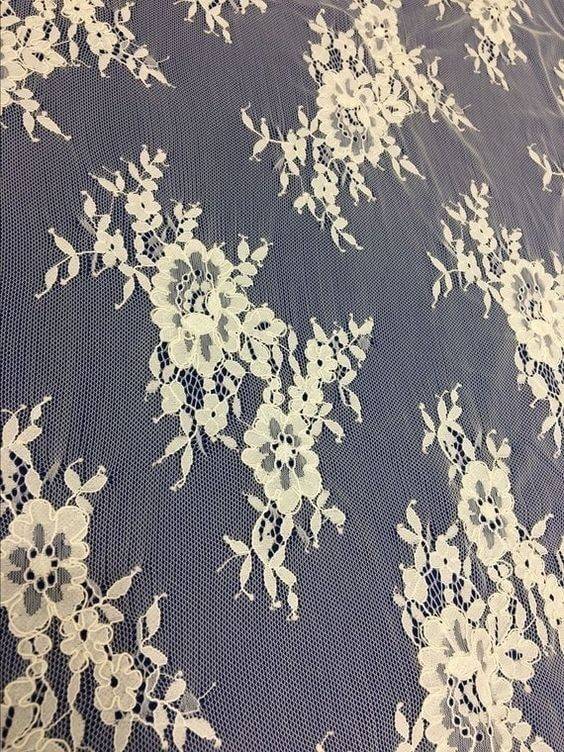
The source outlines needles rising and falling while yarn guides position the threads and move to adjacent needles. The new loop is drawn through the previous one as the sequence repeats. This coordinated motion produces the interlocking structure. The page discusses stable fabrics that resist unraveling and notes options extending from lace-like openness to more closed material. Those are design possibilities within the process family, not proof that every warp knit has identical stretch or strength. Yarn, stitch pattern, density, and finishing determine the actual textile supplied to a manufacturer.
A seamless tube may still need later joins
Woolmark also describes newer equipment producing tubular or three-dimensional forms for activewear and other applications. It explicitly notes that a product called seamless can still require seams during final garment assembly. That qualification distinguishes the knitted component from the complete finished item. A tube may reduce some cutting and joining while still needing sleeves, closures, hems, or other details. For a clear specification, identify the machine route, fabric or component shape, full composition, and remaining assembly stages. Warp knitting offers a set of construction tools, while the actual design determines how they are used in a garment.
Guided yarn movement creates the linked structure
In the source's account, the warp yarns pass through guides that position them around the needles. Repeated needle movement forms new loops through earlier loops, while guide movement links the yarn paths across neighboring positions. The resulting interconnected columns explain why the process is described in relation to the fabric length. This is a construction principle, not a prescription for one uniform surface. An open lace-like fabric and a more closed material can both sit within the broader family. To identify an actual sample, the yarn movement and stitch design need to be connected with density and composition, rather than treating the process name as a complete textile specification.
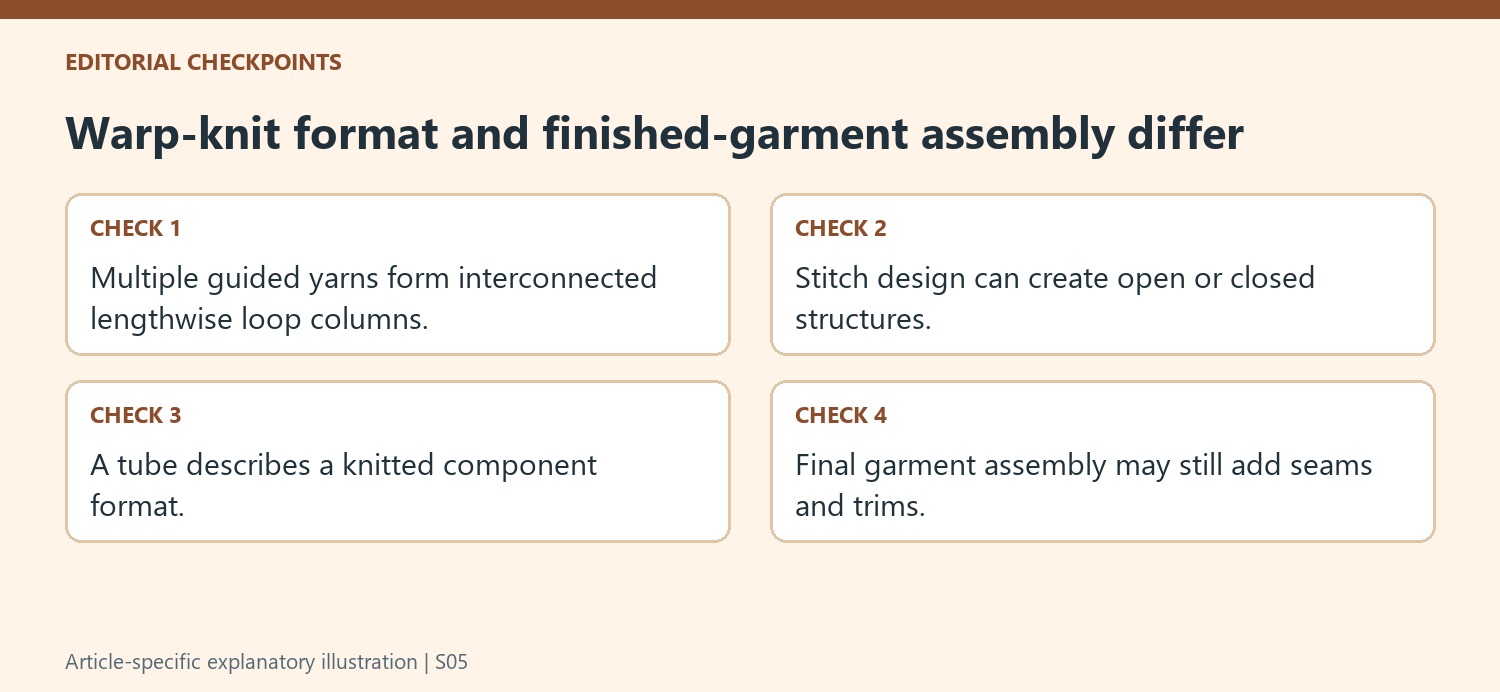
Separate production format from garment completion
The overview discusses flat-width fabrics, tubes, and three-dimensional forms. Those formats describe what the knitting stage can produce and do not necessarily describe an entirely finished garment. Woolmark specifically notes that a seamless tube may still require seams during assembly. A product can therefore reduce certain joins while retaining others in its final design. This distinction matters when explaining waste reduction or next-to-skin contact: the actual pattern and remaining operations determine the result. Identify which parts are knitted together and what must still be attached. That gives a concrete account of the construction without implying that every use of the word seamless means an item has no joining or finishing stages.
Evaluate stability and stretch on the supplied fabric
The page associates warp knitting with stable structures that are difficult to unravel and discusses directional elasticity. Those features introduce useful design possibilities, but the actual behavior depends on yarn, stitch pattern, density, and finish. A more open structure should not be assigned the same properties as every closed structure merely because both were produced by warp knitting. Likewise, a machine's potential production width is not the width of every supplied roll. For a project, request the actual fabric dimensions, composition, and performance information. The technology provides a production family with considerable range, while the chosen construction determines how a particular textile will stretch, handle, and fit its intended application.
References
- Warp Knitting Technology. The Woolmark Company.



Comments
0