 FabricKnowledge Lab
Wear time was part of the study design
Woolmark's body-odor article describes research led by AgResearch with Consumption Research Norway, funded by Australian Wool Innovation. Human volunteers wore base-layer T-shirts, hooded midlayers, and socks made from Merino wool, cotton, and polyester. The question was not simply whether a new fabric smelled neutral. The study examined how many days garments could be worn before odor made laundering necessary. This gives the comparison a use-related context and explains why the garment categories were considered separately rather than merged into one undifferentiated fabric result.
Laundry-energy results follow the washing pattern
The page reports that polyester garments required washing sooner than the wool and cotton examples and presents lower laundering-energy use for the tested Merino items. The reported percentage differences vary between midlayers, base layers, and socks. That variation matters because the figures depend on a particular study design and pattern of care. They are not a universal energy discount attached to any wool garment. A household's washing machine, drying method, load size, wear habits, and reasons for laundering can all influence the practical outcome beyond the odor threshold considered in the study.
Fiber sorption helps explain the interest
Woolmark links odor behavior with the fiber's ability to absorb moisture and hold certain odor molecules until washing. The article also cites research on wool-and-polyester blends, where sorption differed with material composition. These mechanisms provide context for the wearer results without implying that wool stops perspiration or makes washing unnecessary. The useful connection is between material behavior, the decision to launder, and energy consumed during care. To evaluate a product claim, keep the specific garment type and study conditions attached to the result, then consider how closely they match the way the item will actually be used.
The washing decision is part of the energy account
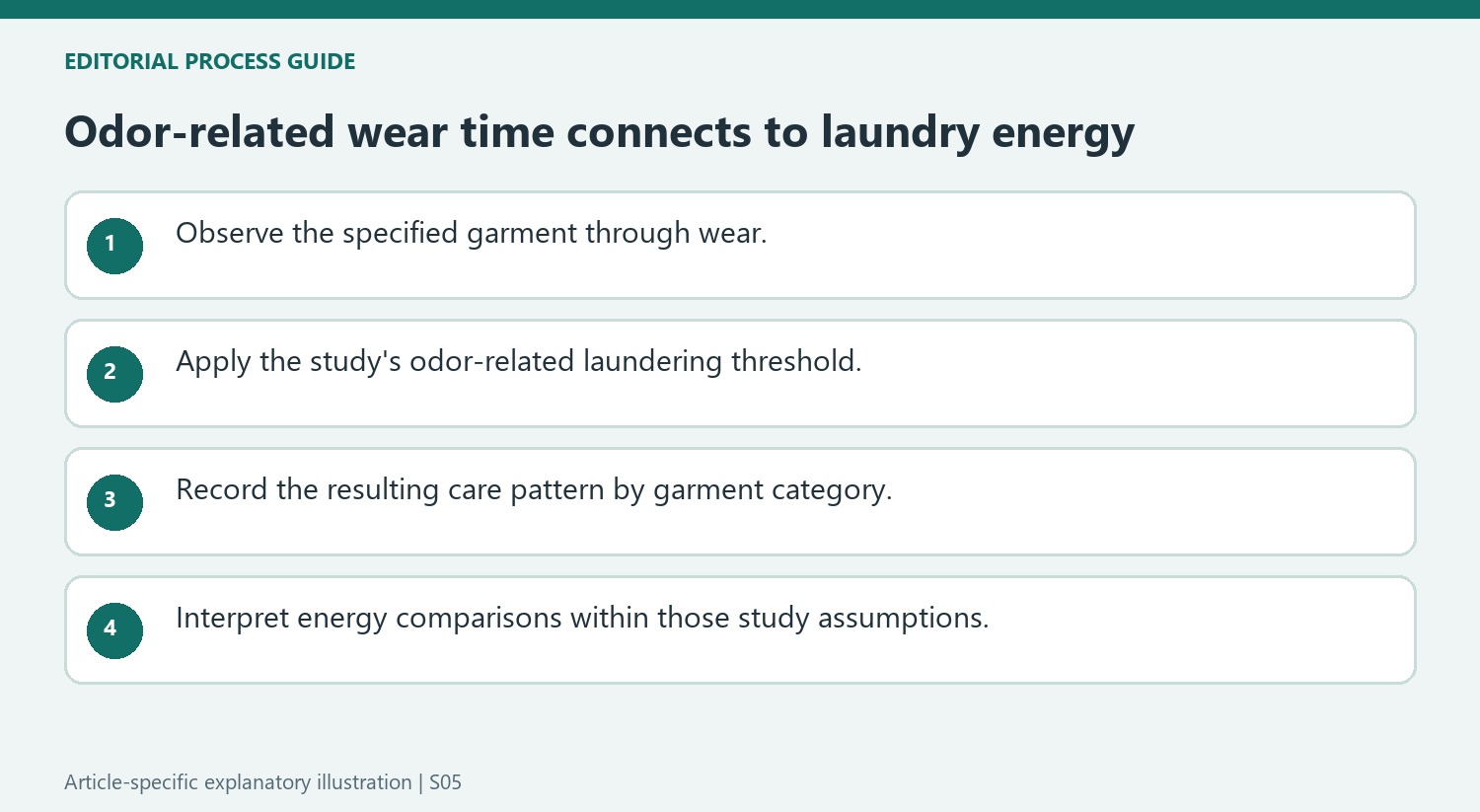
The study summarized by Woolmark follows garments through wear until odor makes laundering necessary. That connects a material property with a behavior and then with energy used in care. It is not simply a comparison of electricity consumed when every garment is washed on an identical fixed schedule. The page reports different results for hooded midlayers, base-layer T-shirts, and socks, showing that the garment category matters. Its figures of 76, 68, and 37 percent lower energy than the polyester comparisons belong to those categories respectively. They should not be averaged or applied as a guaranteed reduction for any wardrobe item, because the underlying washing decisions and care assumptions are part of the result.
Odor intensity and wear duration are related but separate outcomes
The page also cites a New Zealand assessment with thirteen trained smell assessors, reporting lower odor intensity for wool than polyester and cotton in the tested examples. That measurement is not the same as counting days until a volunteer decides a garment needs washing. One describes assessed odor after use, while the other links wear to a laundering threshold. Both can inform discussion, provided their different questions remain visible. A shirt, sock, or hooded layer may also need care for reasons other than odor, including visible soil and the conditions of use. The research does not establish one required number of wears for all products or all people.
Blend studies add another material question
Woolmark discusses Deakin University research on sorption in polyester-and-wool fabrics and reports the highest capacity for the all-wool sample among the tested materials under high-odor conditions. That is a composition-related finding within a defined investigation, rather than proof that any small wool addition produces the same result. It also explains why lower noticeable odor is not equivalent to the odor molecules disappearing. The source describes wool holding molecules within its structure until laundering helps release them. For a finished-product claim, keep the blend and test basis attached, then consider actual care. Material behavior can influence wash frequency, but household equipment, load sizes, drying, hygiene needs, and personal practice remain part of the practical energy outcome.
References
- Wool reduces body odour. The Woolmark Company; The Woolmark Company.




Comments
0