 FabricKnowledge Lab
Changing appearance within the fiber offering
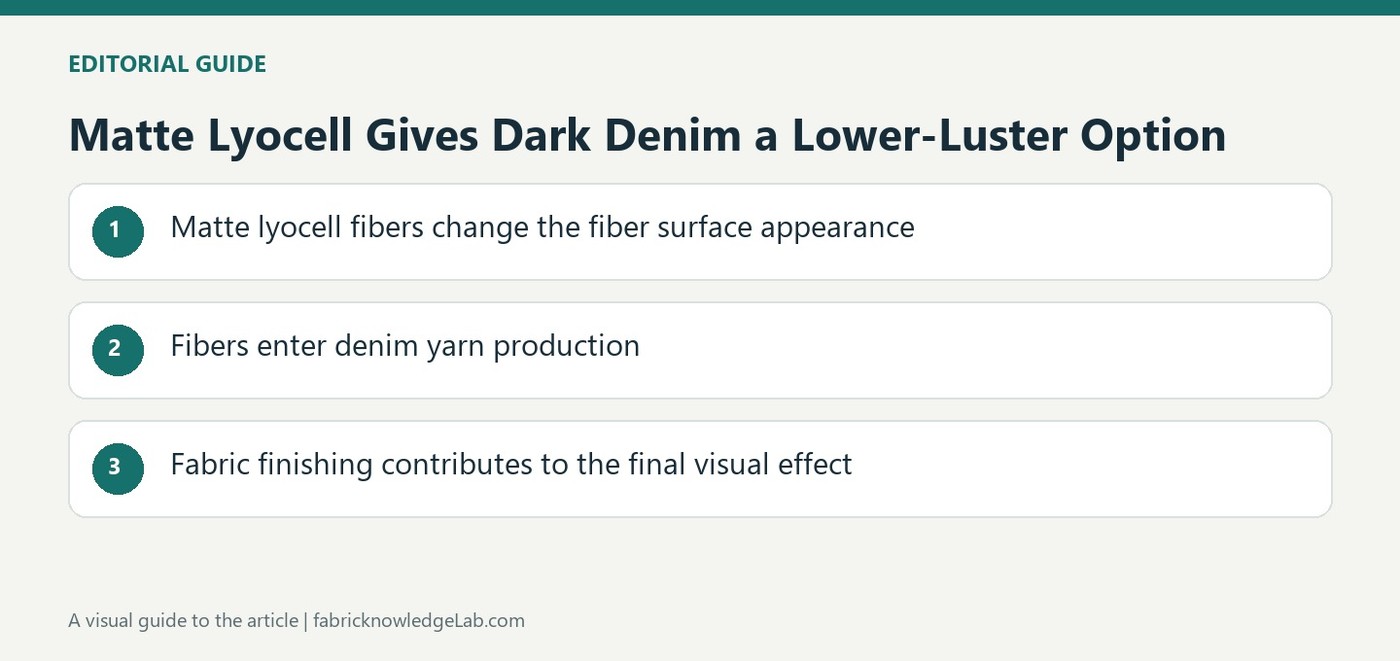
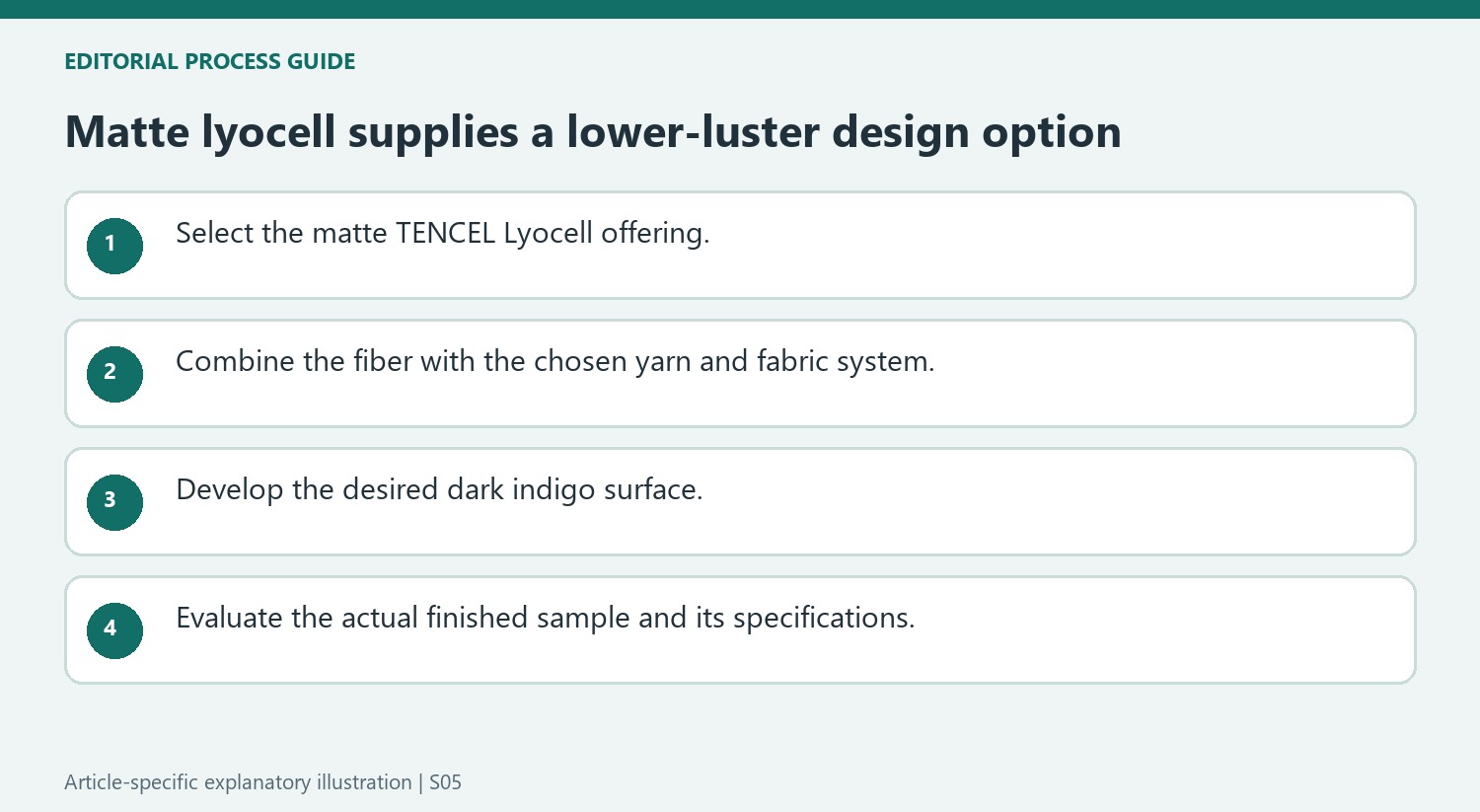
Lenzing's announcement introduces a matte version of TENCEL Lyocell for denim development. The company positions it as a way to give dark indigo fabrics a deep, low-luster appearance while retaining the smoothness associated with its standard lyocell offering. This is an aesthetic choice within a fiber range, rather than a claim that every denim fabric should be glossy or matte. The desired surface depends on the garment design, yarn, construction, and finishing. A designer seeking a quieter dark appearance may select a different material combination from one intended to emphasize sheen or contrast.
Mill partnerships turn fiber into fabric options
The report names collaborating mills in several countries, including Advance Denim, Artistic Fabric Mills, Arvind, Kipas Denim, KG Denim, Panther Denim, and Textil Santanderina. It describes presenting the fiber through the Kingpins Digital Show. These details place the launch within a textile-development network: a fiber supplier provides a material option, while mills develop fabrics around it. The list of partners does not establish that every mill's fabric uses the same blend or finish. Instead, it shows how a common fiber characteristic can be explored across different denim collections and production settings.
Tracing and environmental claims answer separate questions
Lenzing describes physical identification technology that supports tracing branded fibers and discusses the closed-loop solvent process used in their production. Traceability concerns identifying the material and its source, while production-impact claims concern how it was made. Neither automatically measures the complete environmental footprint of a finished pair of jeans. The announcement is most useful when those distinctions remain clear: matte appearance is an aesthetic feature, fiber identification is a supply-chain tool, and manufacturing statements have defined process boundaries. The finished fabric and garment still need their own specifications and supporting evidence for any broader claims.
The stated mechanism concerns the way light is scattered
Lenzing describes the new fiber as specially designed to scatter light and reduce the sheen of conventional lyocell denim applications. That locates the innovation within the fiber offering rather than simply specifying a darker blue dye. A dark fabric can still show noticeable luster, so depth of color and surface shine are useful separate design questions. The announcement says the aim was a deep, low-luster appearance for indigo fabrics in response to customer demand. The finished effect still belongs to a textile made from particular yarns, blends, construction, and finishing. The fiber description provides an option for those design decisions rather than a complete recipe for every matte-looking denim.
A mill network can develop several interpretations
The named partners span China, Pakistan, India, Turkey, and Spain, showing that the launch involved several fabric-development settings. Advance Denim, Artistic Fabric Mills, Arvind, Kipas Denim, KG Denim, Panther Denim, and Textil Santanderina appear as collaborators rather than as suppliers of one identical cloth. Their inclusion helps explain the relationship between a fiber innovation and the fabric market: a shared input can be combined with different materials and processes to produce multiple offerings. For a designer comparing samples, the relevant specification is therefore the particular mill's fabric. A common branded fiber is useful identification information, but it does not establish identical weight, composition, finish, or garment suitability across all partner collections.
Keep low luster, identification, and production apart
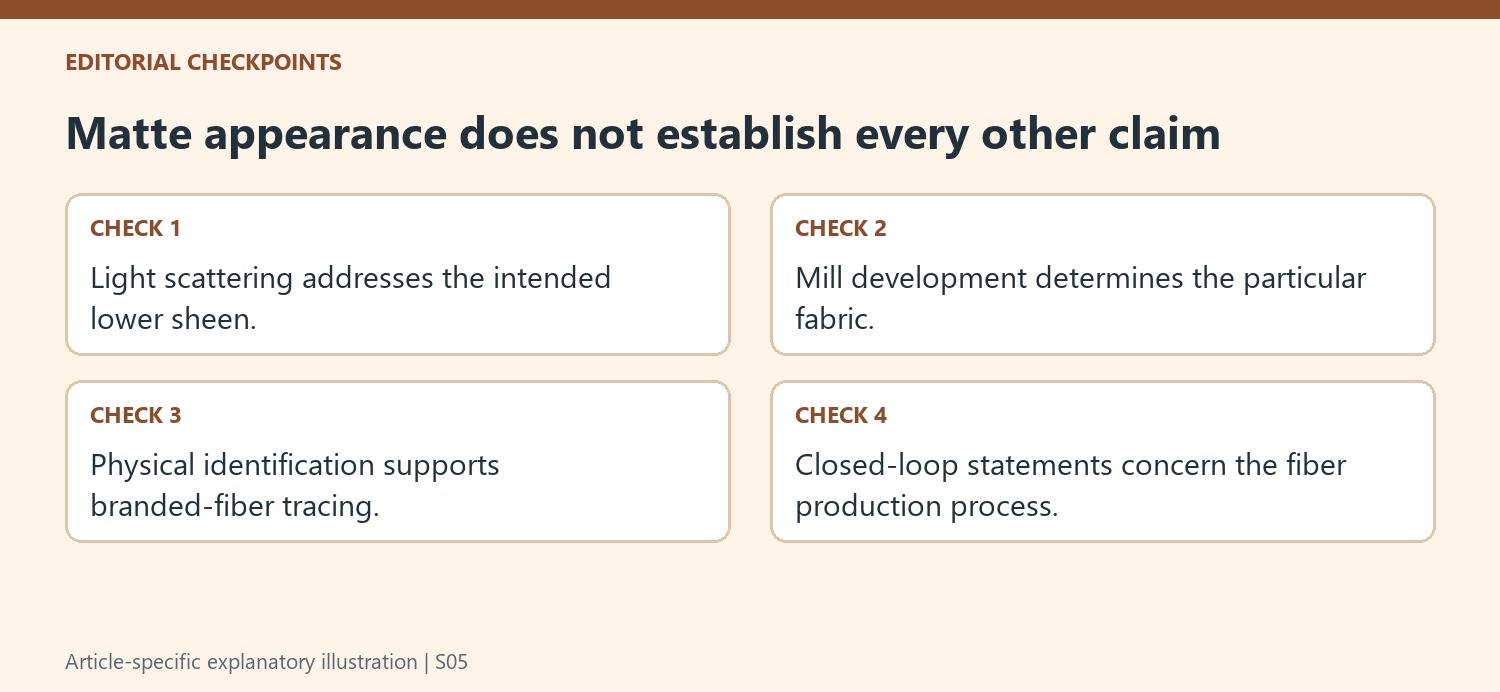
The announcement brings together three ideas that should remain distinct in a product description. The matte feature addresses appearance; physical fiber-identification technology addresses authenticity and tracing; the closed-loop production account concerns manufacturing. None independently establishes all the others. For example, an attractive low-luster surface cannot demonstrate the history of a fiber, while an identification result does not measure the environmental impacts of cutting and finishing a pair of jeans. Lenzing presents the new type as retaining standard lyocell benefits, but a finished garment still needs its own description and evidence for any stronger claim. This separation lets readers understand the innovation's intended contribution without converting a material announcement into an unrestricted assessment of a complete product.












Comments
0