 FabricKnowledge Lab
Fineness within a cellulose-fiber family
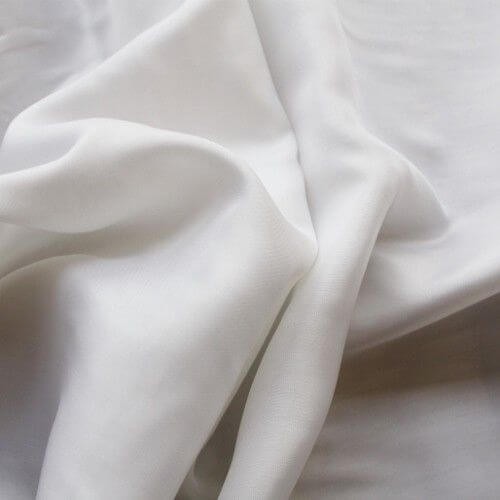
MicroModal is associated with a finer version of modal, a regenerated cellulose fiber. Sewport's guide emphasizes the small fiber size and connects the material with underwear, sleepwear, loungewear, and bedding. That focus helps distinguish the description from a completely unrelated raw material: the central idea is refinement within a modal-fiber family. A fine fiber can contribute to a smooth textile surface, but the resulting article still depends on yarn and fabric construction. A lightweight underwear knit and a bedsheet need not feel or behave identically just because their product descriptions mention the same fiber.
From prepared cellulose to fine strands
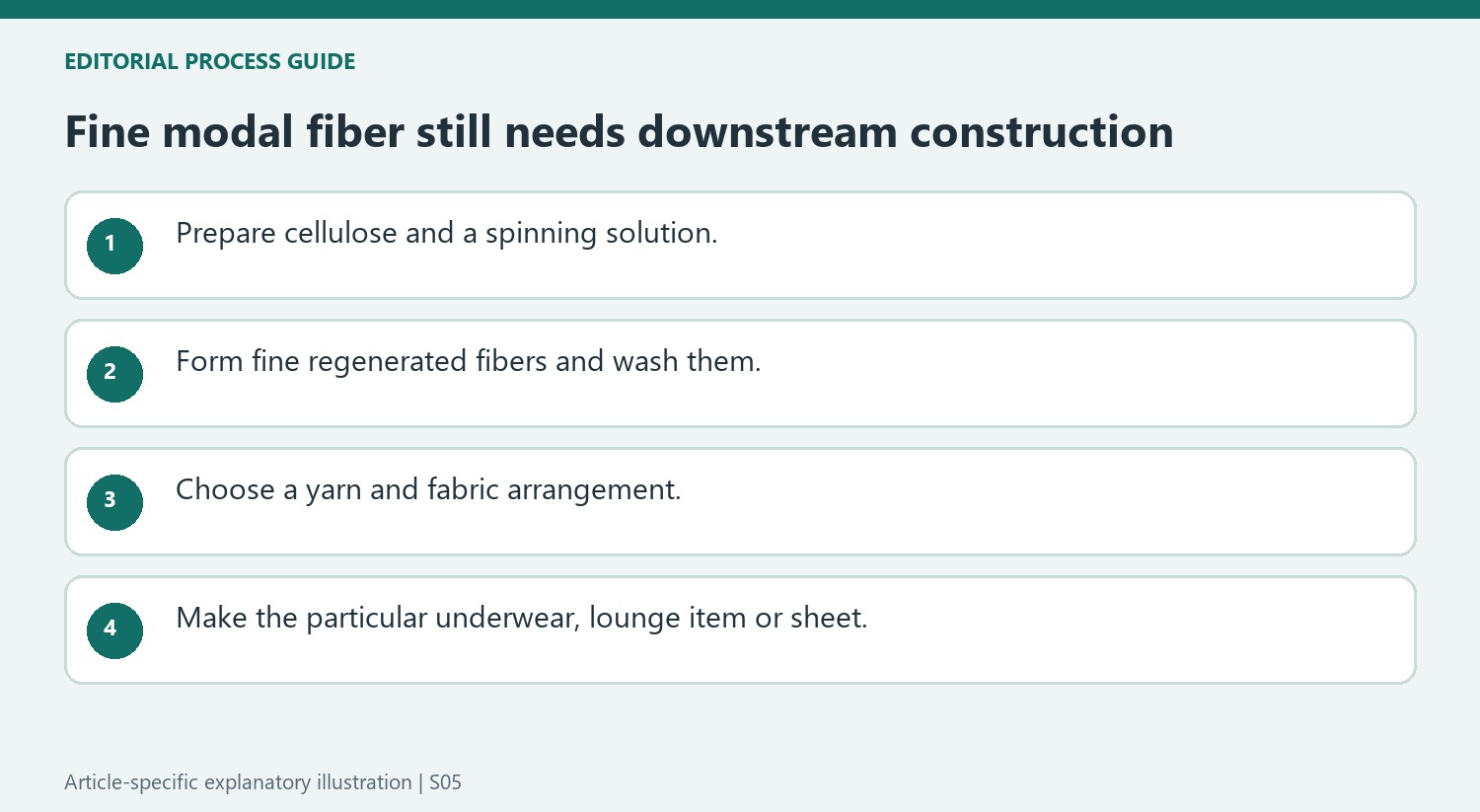
The manufacturing account follows the general modal route. Cellulose is extracted and purified, chemically prepared, and made into a solution that can be forced through a spinneret. Fine openings form streams that are regenerated as fibers, washed, and prepared for later spinning. The guide identifies fiber size as the main distinction from its account of ordinary modal. These stages explain why the material is classed as regenerated cellulose rather than a fiber collected directly from a plant in its final textile form. Wood supplies the cellulose, while manufacturing determines the form in which it reaches the textile producer.
Soft-touch applications need complete labels
Sewport's examples center on products used close to the skin, where buyers often prioritize touch and lightness. Underwear, nightwear, loose lounge garments, and sheets illustrate that emphasis. However, descriptions such as silk-like or exceptionally soft are comparisons of experience, not a complete technical specification. They do not establish universal antibacterial behavior, identical durability, or impact-free production. To assess a particular item, read the full composition and care information and examine the construction. Claims concerning environmental performance or tested properties should be linked to the relevant manufacturer and product rather than inferred from fineness alone.
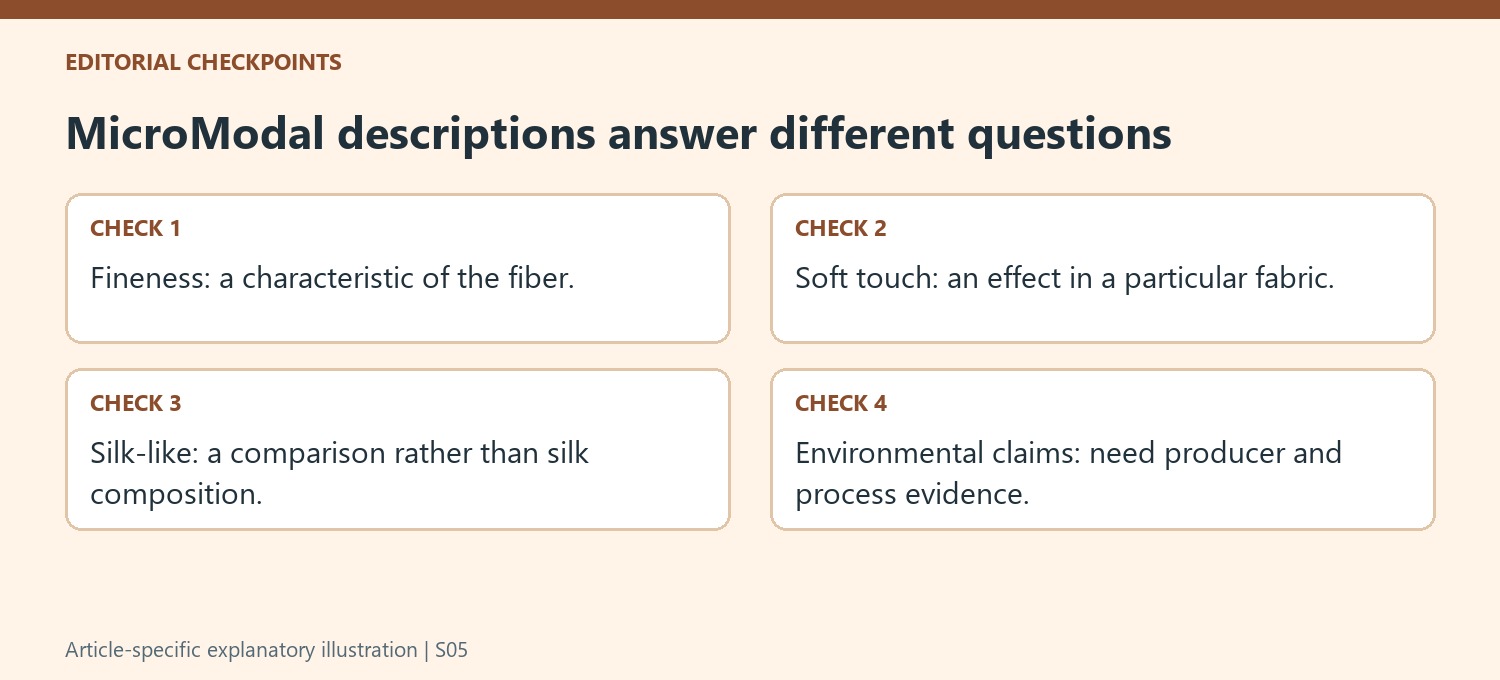
Fineness describes the fiber before the garment
The central distinction in the source is a finer strand within the modal family. That is a useful material-level description, but it is not a measurement of the thickness of every finished fabric. Fine fibers can enter yarns of different sizes and textiles of different constructions. Consequently, the word fine should not be used as a shortcut for transparent, fragile, or universally lightweight clothing. The guide's sleepwear and underwear examples show how producers can choose the material for a soft-touch application. They do not demonstrate that every product with the same fiber description has the same yarn, structure, or handling characteristics. A fabric sample and its specification provide information that the fiber name alone leaves open.
A comparison with silk concerns an effect
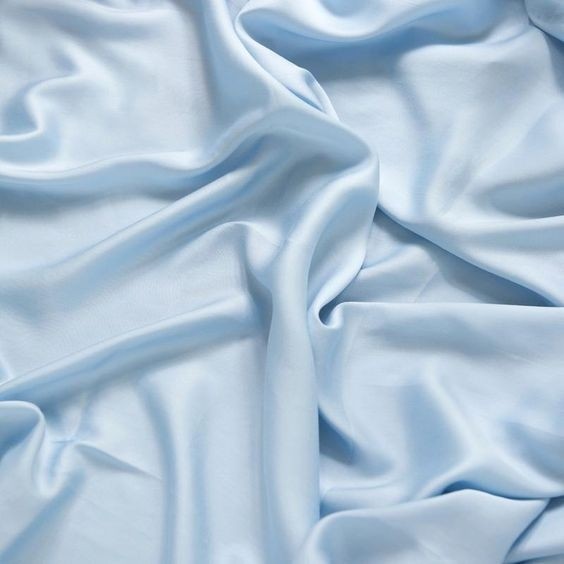
When a product is described as silk-like, the comparison usually draws attention to a perceived smoothness or softness. MicroModal remains regenerated cellulose rather than silk. A similar touch therefore should not be extended into an assumption about identical composition, cleaning requirements, strength, or moisture behavior. The source's range of applications also includes loose lounge garments and sheets, which are not built like close-fitting underwear. For practical selection, compare actual products intended for the same task and read their complete labels. This keeps a useful sensory description from turning into a universal technical claim. It also leaves room for personal preference, since a desirable hand or drape is not established by a superlative in a material guide.
Manufacturing claims require more than a refined name
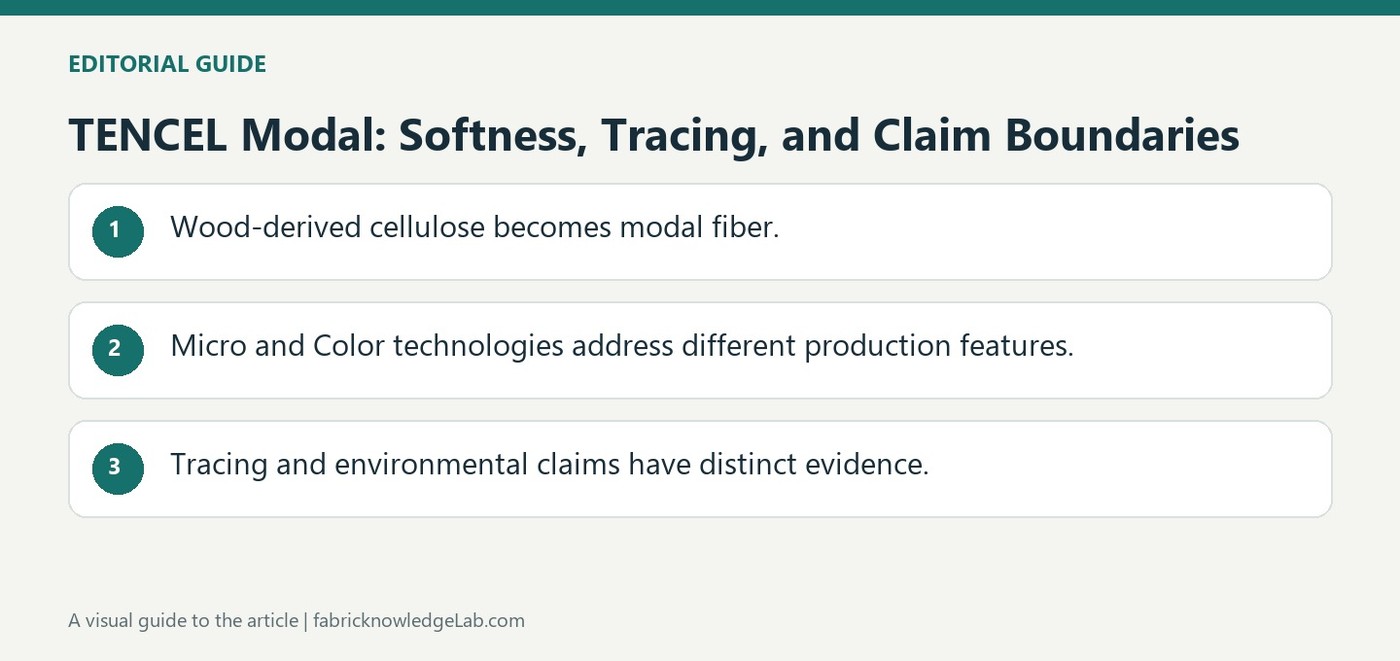
The process account still involves preparing cellulose, creating a spinning solution, regenerating fiber, and washing it. A finer fiber does not make those operations disappear. Claims about forestry, process-chemical recovery, emissions, or manufacturing location need their own supporting records and a defined producer. The guide contains broad environmental language, but fineness itself is not proof that a process has no impacts. Likewise, a particular brand reference should be distinguished from the generic modal category when identifying a textile. A buyer can ask which fiber was supplied, what proportion is present, and which claim the available documentation actually supports. This provides a more useful basis for comparison than treating a refined material name as a complete supply-chain guarantee.




Comments
0