 FabricKnowledge Lab
A dated launch for nonwoven products
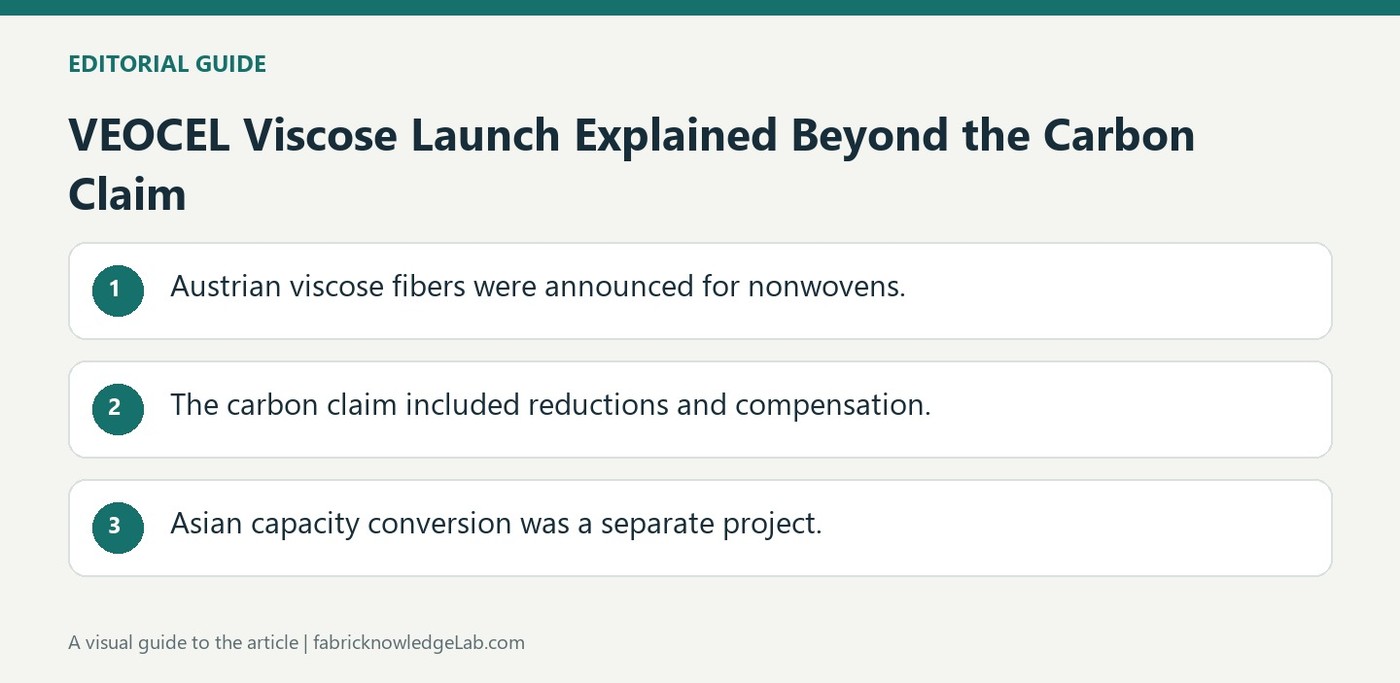
Lenzing's announcement describes the expansion of its VEOCEL viscose portfolio for nonwoven applications, including wipes and absorbent hygiene products. The Austrian-made offering was scheduled to become available from May 1, 2023, for Europe and the United States. This timing matters: the document records a particular product launch and accompanying plans, rather than providing a current inventory of every fiber sold today. The company positions the material around liquid management and everyday care products, placing it in a different application context from the woven or knitted fabrics used for most clothing.
What carbon neutral meant in the announcement
The reported carbon-neutral designation combined several actions. Lenzing says emissions were measured and reduced at its integrated Austrian site, where wood-to-fiber production and energy sources including biomass and solar power contributed to the approach. Remaining emissions were balanced through financing climate projects, with ClimatePartner involved in the program. The claim therefore did not mean production generated no emissions. It depended on a stated accounting boundary, reductions, and compensation for the remainder. Keeping those elements together gives readers a more accurate understanding than repeating the label without its explanation or extending it automatically to a complete consumer product.
Separate conversion plans and partnerships
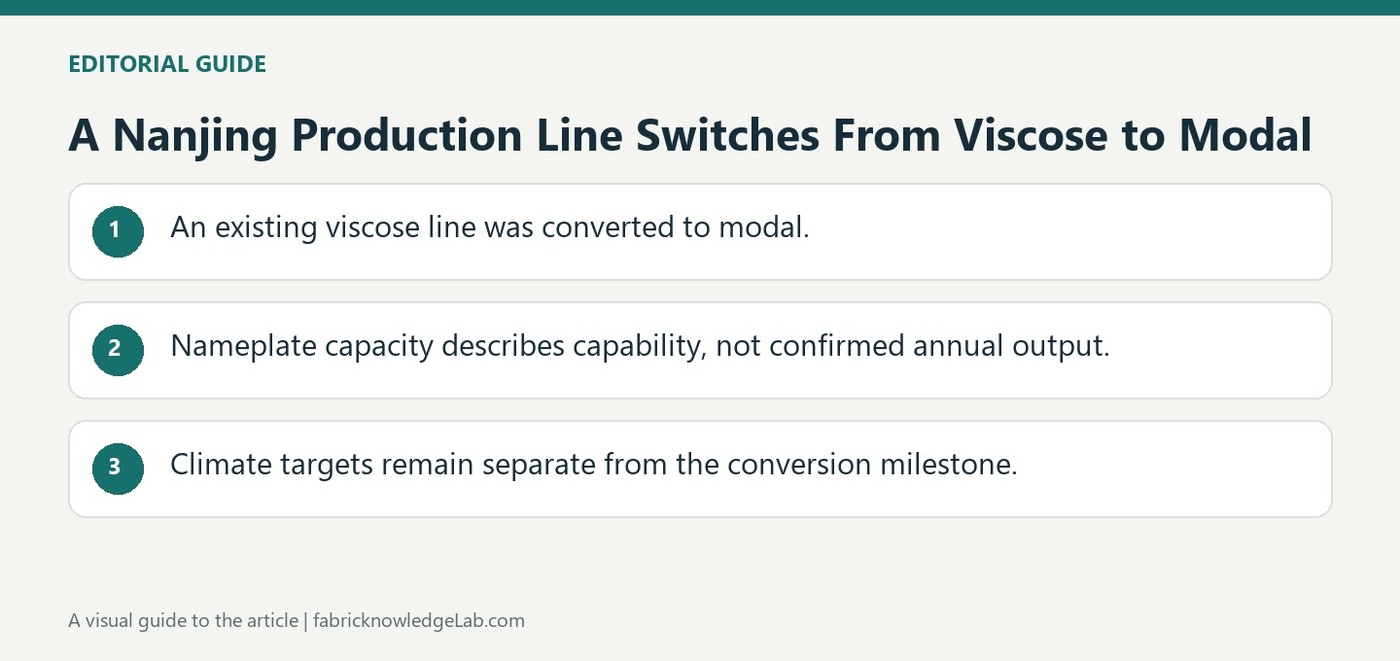
The same announcement described converting conventional viscose capacity in Asia into specialty-fiber capacity, with completion expected in the second half of the announcement year. It also discussed cooperation with nonwoven producer Suominen, including roll goods made using the new viscose offering and an earlier lyocell collaboration. These are related supply-chain developments but distinct claims. A fiber launch, a planned plant conversion, and a finished nonwoven each represent different stages. Their environmental descriptions should remain attached to the specific material and activity documented, rather than being treated as a single unrestricted guarantee.
The carbon-neutral description includes compensation
The VEOCEL release explains a sequence of measuring emissions, reducing them and balancing the remainder through financed climate projects. That last step is part of the claim. Carbon neutral in this announcement does not mean the physical production process emits no greenhouse gases. Keeping the sequence visible makes the statement more precise and allows a reader to distinguish operational changes from compensation measures. The report also describes renewable energy sources and an integrated Austrian site as contributors to reduction. Those features concern the specified production route, rather than proving that every later wipe, hygiene product or mixed nonwoven made with the fiber has no associated emissions across its whole lifecycle.
The Austrian launch and Asian conversion are different events
The release identifies availability from May 2023 for the Austrian fiber offering and separately discusses converting existing conventional-viscose capacity in Asia. Its reference to completion later in the year belongs to the time of that announcement, not a new timetable starting whenever the page is read. This distinction is important when summarizing a historical product launch. A stated plan should not become a claim that every described conversion was already completed unless later evidence confirms it. The useful account identifies what was launched, where it was produced and what additional capacity changes were announced, keeping those statuses separate rather than merging them into one worldwide production statement.
Fiber supply and nonwoven manufacture occupy different stages
Lenzing describes the fiber as intended for wipes and absorbent hygiene applications and discusses collaboration with Suominen on nonwoven roll goods. That relationship connects a fiber offering with a material that downstream customers can use in products. It does not imply that an individual fiber name describes the entire wipe, including any other fibers, binders or added formulation. The finished item still needs its own composition and use information. Likewise, effective liquid management is a functional statement separate from the carbon-accounting claim. Reading those aspects independently gives the product development a clearer shape: a specified fiber supply, a conversion into nonwoven material and a further route toward a completed everyday-care product, with evidence attached to each stage.






Comments
0