 FabricKnowledge Lab
An award for a different coloring stage
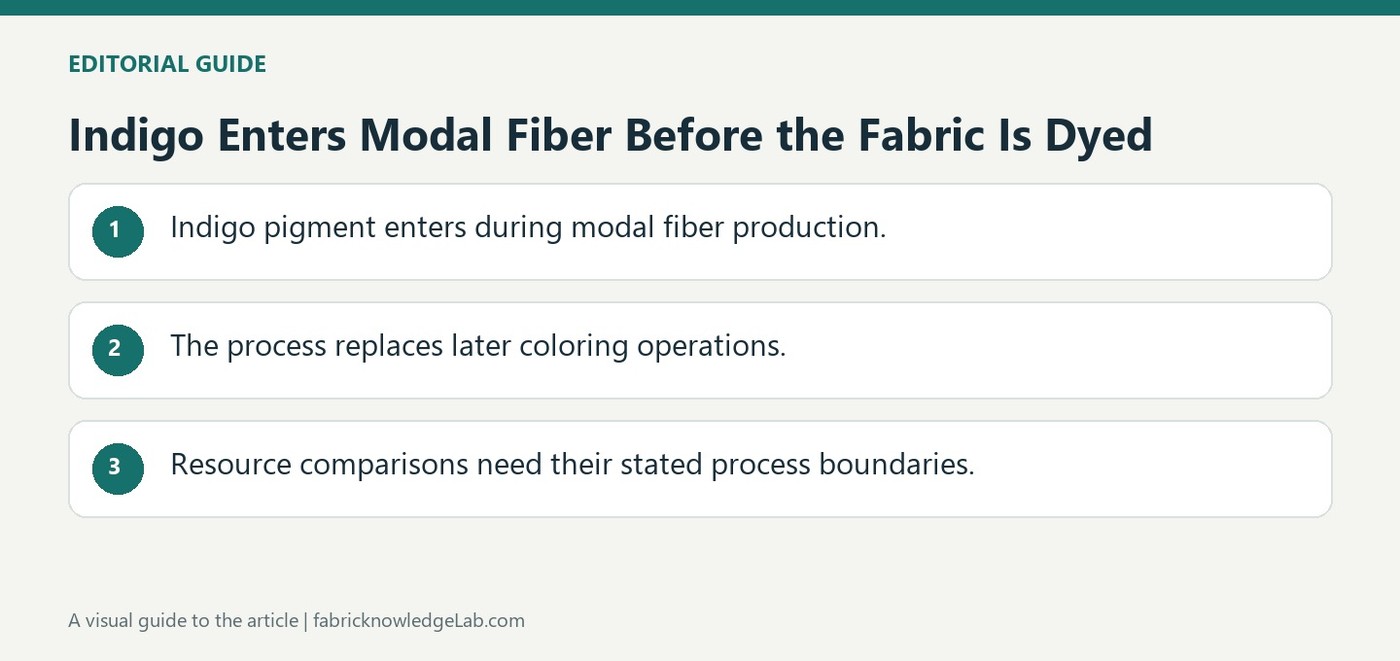
Lenzing's September 2022 announcement reported an ITMF Sustainability and Innovation award for TENCEL Modal with Indigo Color technology. The company said the technology had first launched in 2021 and received recognition at the federation's annual conference in Davos. Its central distinction is where color enters the production chain. Indigo pigment is incorporated into modal fiber during production through a spun-dyeing approach. This differs from coloring an already formed yarn through a conventional indigo dyeing route. The change concerns the material's manufacturing sequence, rather than simply offering another blue shade on an otherwise unchanged process.
Read the stated comparison carefully
The announcement reports substantial reductions in water, electricity, chemicals, and heat energy compared with traditional rope-dyed indigo yarns. Those are the company's comparisons between specified production approaches. They should not be translated automatically into identical percentage savings for every finished pair of jeans, because garments also involve fabric manufacture, finishing, cutting, sewing, transport, and use. The useful takeaway is the process distinction behind the numbers: introducing pigment at the fiber stage can replace later coloring operations. Any broader environmental claim needs its own boundaries and supporting assessment instead of borrowing the fiber-stage result without qualification.
Applications extend beyond conventional denim
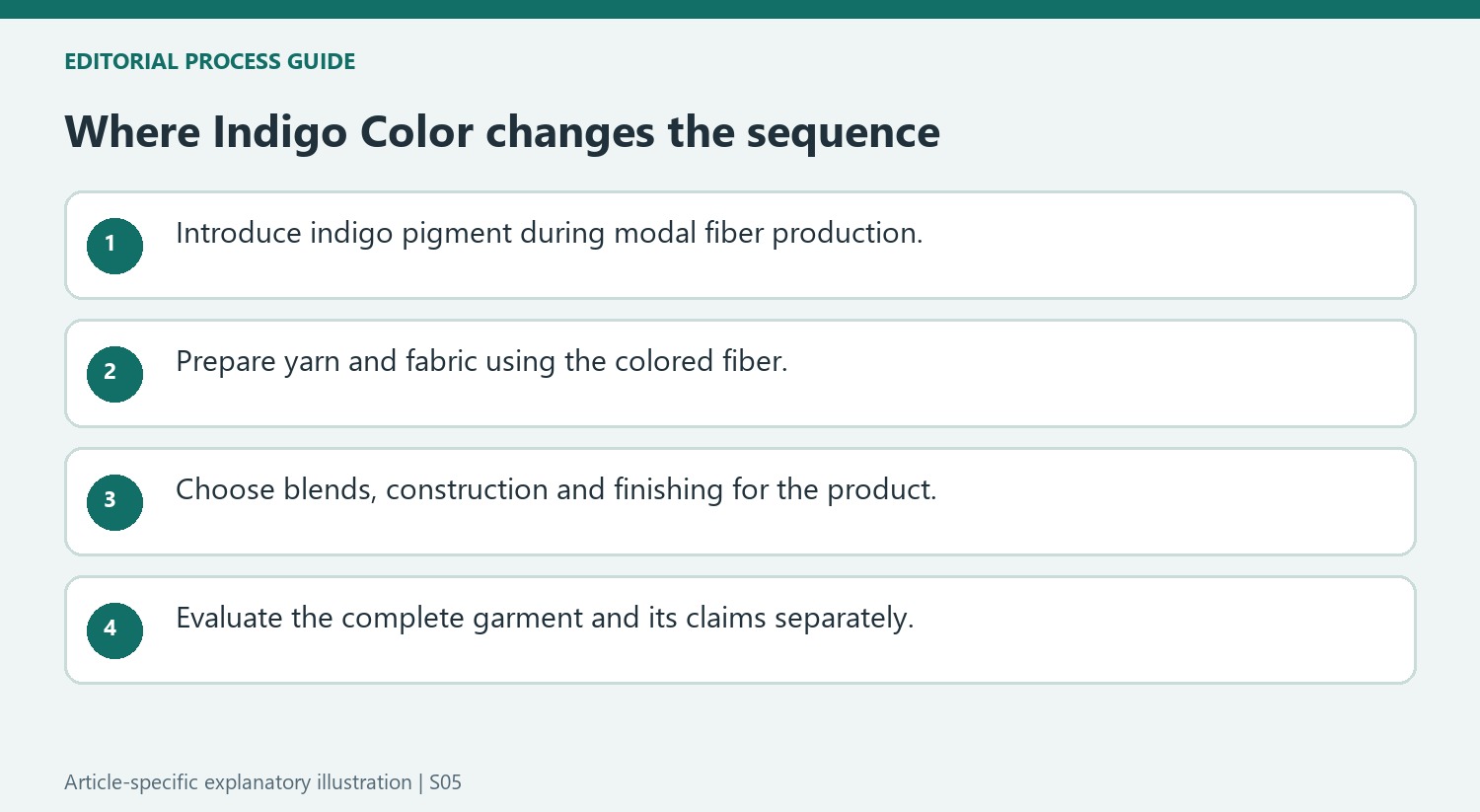
Lenzing describes opportunities in denim, outerwear, active clothing, footwear, and knitwear, with further exploration of washes, effects, and fiber blends. The article also mentions product designations and certification associated with the fiber at the time. These details indicate a development platform with several possible downstream uses, rather than one standardized finished fabric. A textile producer still has to choose the blend, yarn, construction, and finishing needed for a specific product. The award documents recognition of the coloring technology; it does not remove the need to assess the performance and claims of the final article separately.
Follow the pigment through the production sequence
The useful starting point is the distinction between a colored fiber and a later-colored yarn. In Lenzing's account, indigo pigment enters while modal fiber is being produced. The color is therefore already associated with the fiber before subsequent textile operations create the desired yarn and fabric. Traditional rope dyeing introduces indigo at a different stage. This is a change in process design, not evidence that a final garment requires no other manufacturing work. Spinning, fabric formation, finishing, and garment assembly still have their own requirements. A clear explanation should locate the changed step precisely so readers can understand both the innovation and the remaining work needed to turn that fiber into clothing.
Keep the award distinct from the comparison figures
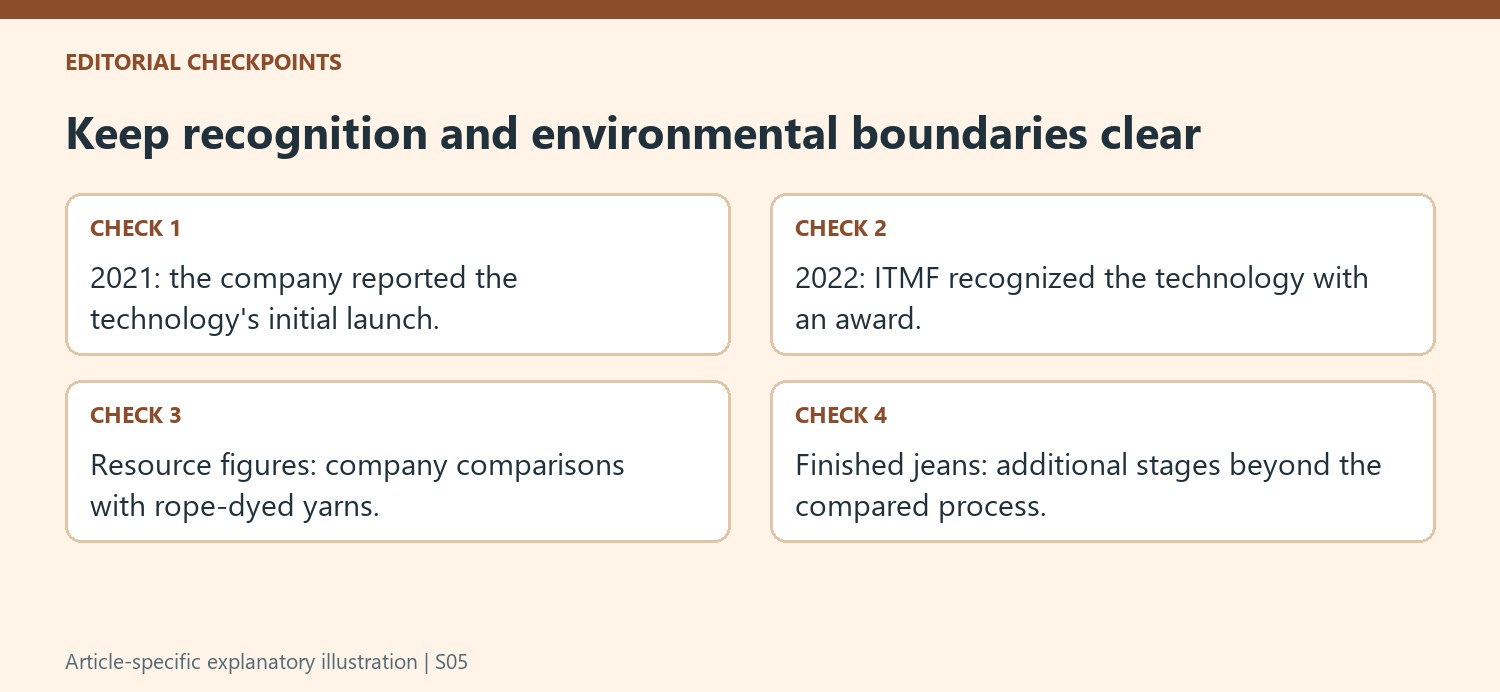
The ITMF award records recognition by an industry organization in 2022. The resource figures in the release are separately presented as Lenzing's comparison with traditional rope-dyed indigo yarns: around 99 percent less water and electricity, 80 percent fewer chemicals, and 100 percent less heat energy for the compared process. Those statements concern a defined coloring approach and reference case. The award itself is not a separate test report for every number or a certification of a finished pair of jeans. Reporting the recognition and the manufacturer's figures as distinct pieces of information preserves their meaning. It also avoids implying a complete absence of environmental impacts across the product's life simply because one process-energy category is reported as eliminated.
Innovation leaves room for different finished products
The release's references to washes, effects, fiber blends, and knitwear show that the technology was intended as a platform for development. A producer could explore an indigo-colored material without reproducing every feature of conventional denim. That flexibility makes the source relevant beyond one familiar jeans construction, but it also means the finished results cannot be treated as interchangeable. A knit top, an outerwear fabric, and a footwear component have different design tasks. Their complete compositions and manufacturing choices should accompany any description of the fiber. The company’s historical claims about designations and certification should likewise be tied to the relevant product and period, with current documentation checked before making a new commercial claim.






Comments
0