 FabricKnowledge Lab
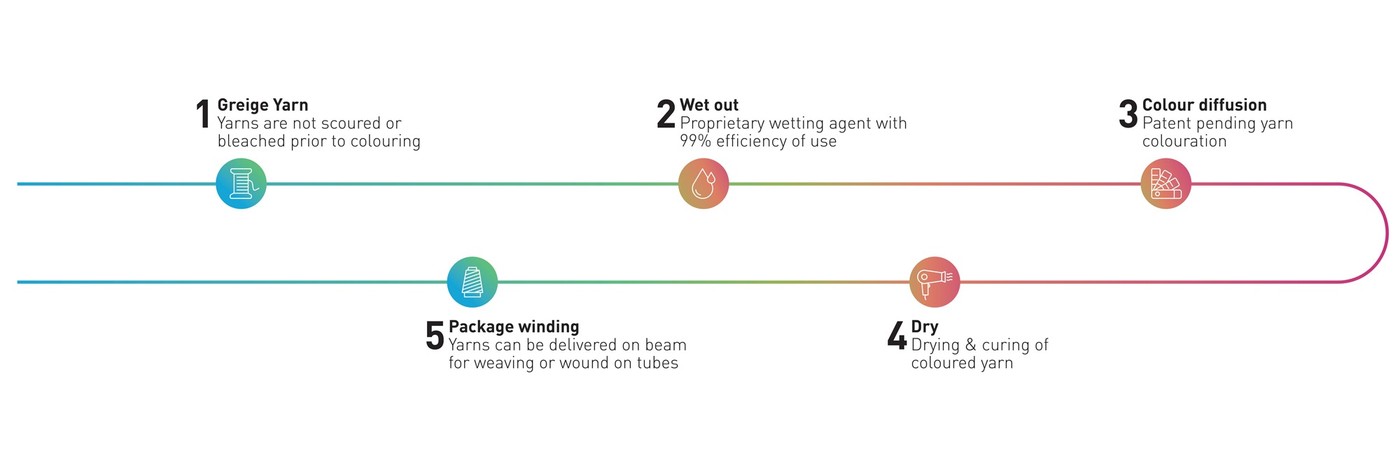
Color is applied within the yarn bundle
Woolmark describes QuantumCOLOUR from COLOURizd as a continuous coloring method for greige yarn. Pigment and binder are introduced into the yarn's fiber bundle, followed by a drying and curing stage at a selected temperature. This differs from treating the process as a conventional large dye bath. The description concerns a yarn-coloring route before that yarn becomes knitted or woven fabric. It should not be mistaken for a household recoloring technique or for printing a finished image onto an already assembled garment.
Resource claims need their stated scope
The page repeatedly emphasizes low water use and gives a figure of about 0.5 liters per kilogram of yarn. It also explicitly clarifies that the process is not entirely waterless, despite describing the continuous application stage without a conventional water bath. That distinction matters when reporting the technology accurately. Woolmark associates the route with fewer pretreatments, reduced wastewater, and controlled dosing of wetting agent, pigment, and binder. These are claims about the described coloring process, not a complete water-footprint measurement covering farming, yarn manufacture, garment production, and consumer laundering.
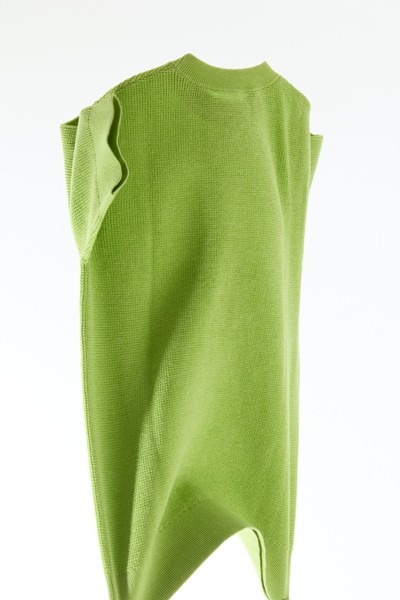
Trials covered wool and several blends
Woolmark reports testing on 100% Merino wool and blends containing cotton, TENCEL, or nylon, across a stated range of yarn counts. It says authorized laboratory partners assessed yarns, fabrics, and garments against its colorfastness and durability methods. The ability to color several fiber types using one chemistry is presented as a way to simplify the complexity of coloring blends. For a mill or product developer, the useful questions are whether the actual yarn falls within the validated range and whether the resulting color and handle meet the product's requirements, rather than assuming every fiber blend has already been tested.
Pigment and binder play different roles in the process
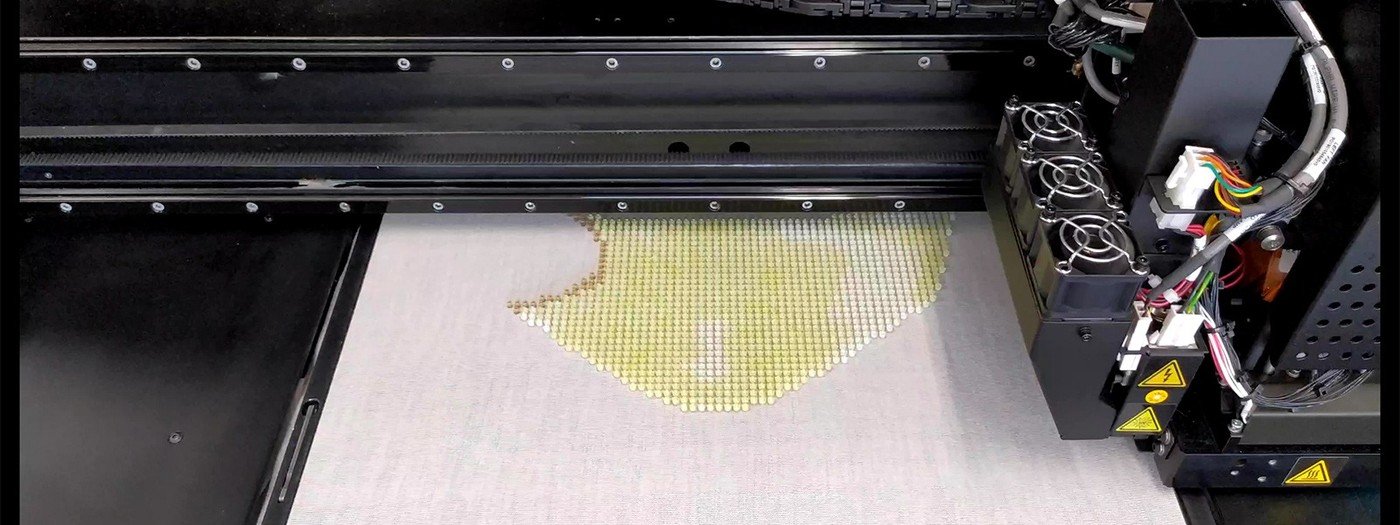
The QuantumCOLOUR description places both pigment and binder into the yarn bundle. The colorant supplies the visual effect, while the binder belongs to the system that establishes the finished coloration. Drying and curing follow at a selected process temperature. This sequence makes the route different from an image printed onto a finished garment, even though both can involve controlled color application. The yarn still has to enter knitting or weaving afterward. When evaluating a demonstration, identify whether it shows the colored yarn, the resulting fabric or a garment made from it. Each stage provides different evidence, and a successful yarn coloration trial does not by itself show every possible construction or end-use requirement.
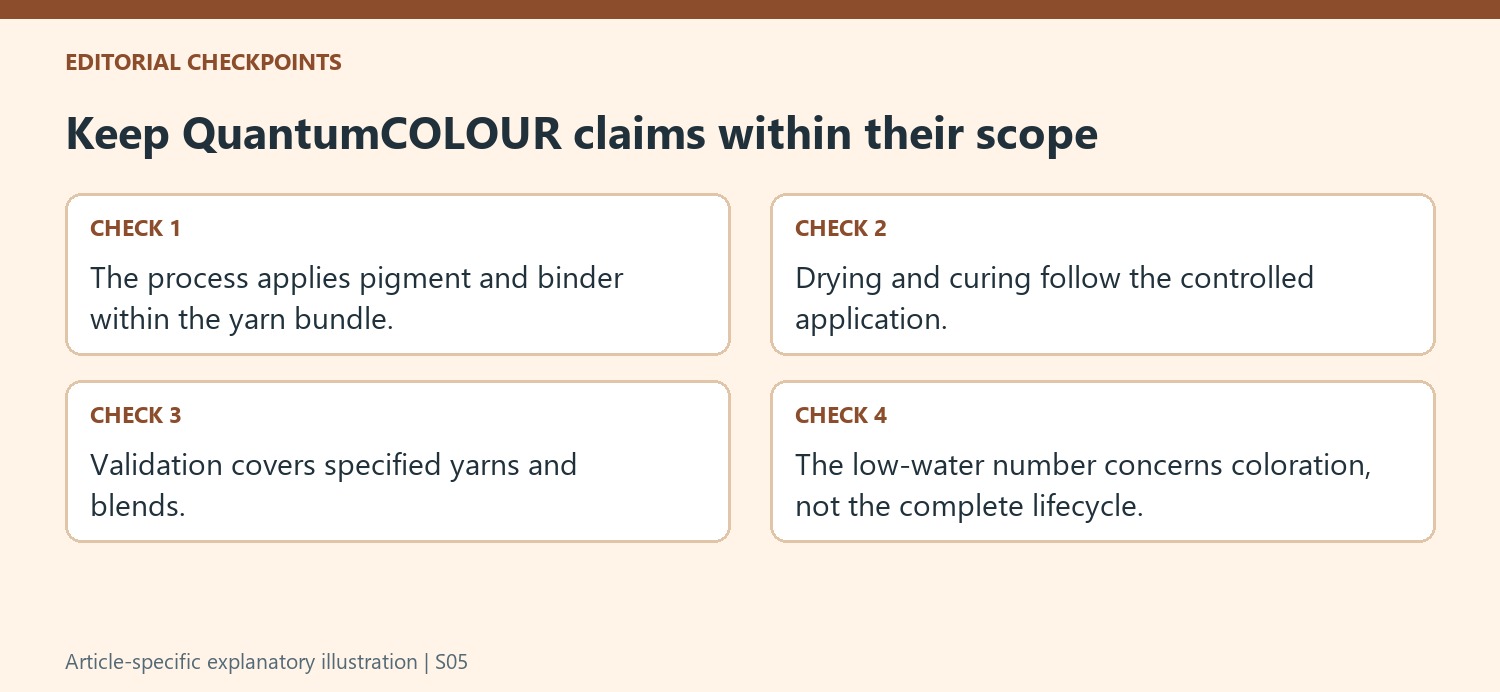
Validation applies to a stated set of trials
Woolmark reports work on Merino and blends involving cotton, TENCEL or nylon, with yarn counts ranging from 30/2 NM to 80/1 NM. These details establish a trial range rather than universal approval for every fiber combination and yarn format. The page also describes assessment of yarns, fabrics and garments through authorized laboratory partners. That is useful because processing can be examined at more than one point in the product route. A developer still needs to determine whether the actual proposed yarn is covered by the evidence and whether the finished shade, handle and durability suit the intended use. The named technology should start a specific compatibility discussion rather than end it.
Keep the water figure attached to coloration
The source gives a small water-use figure for the described coloring process and also clarifies that it is not entirely waterless. That qualification should stay visible whenever the number is repeated. It does not measure water used to grow the fiber, prepare all yarn inputs or launder the final garment. Likewise, avoiding a conventional dye bath is a statement about a process configuration, not proof that every upstream or downstream activity disappears. The most useful comparison identifies the same production boundary on both sides. Ask what is included, what is excluded and what material is being colored. This preserves the potential significance of resource savings without converting a narrowly described process result into an unsupported claim about the entire product lifecycle.
References
- COLOURizd™ QuantumCOLOUR™ Technology. The Woolmark Company.












Comments
0