 FabricKnowledge Lab
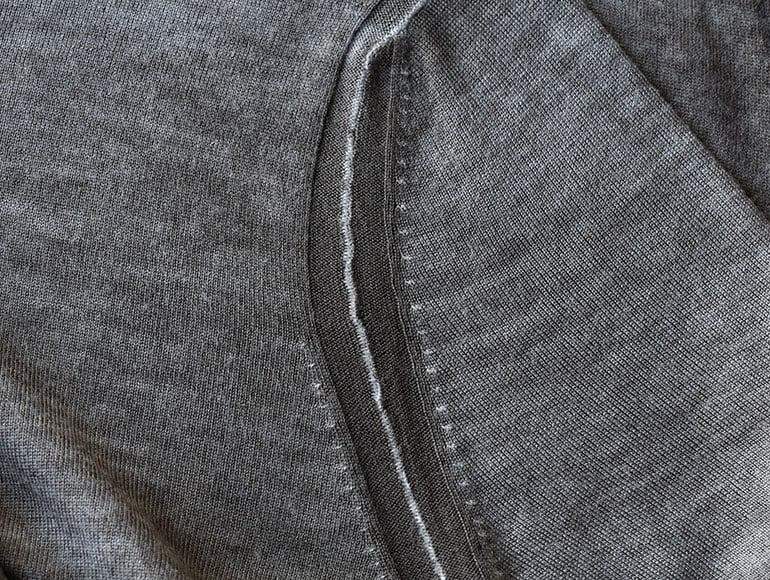
The worn-in appearance is deliberately produced
Merino wool is often valued for vivid and durable color, which makes a convincing faded appearance a specific processing challenge. Woolmark's Vintage Knits description distinguishes its approach from simply applying pigment with a binder. The source associates that older route with poorer handle and rubbing fastness. The aim is instead to reproduce the uneven color seen in washed garments, especially around raised areas and seams, through controlled garment dyeing. The variation is a designed feature, not merely an uncontrolled failure to dye every part of a textile equally.
Fast dye application changes where color develops
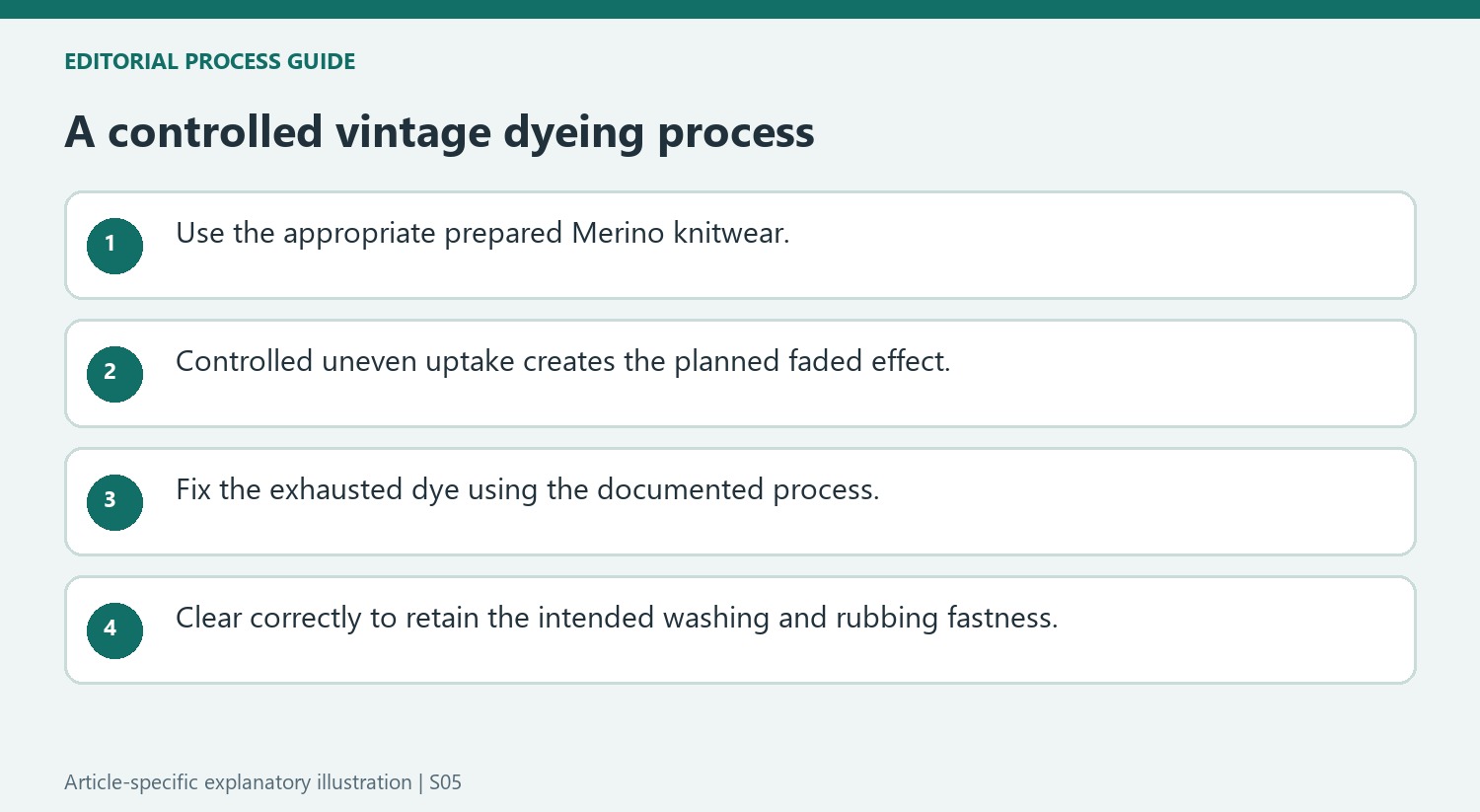
The process described uses reactive dyes on easy-care or mercerized Merino knitwear, with more acid and rapid exhaustion at the strike temperature. Woolmark gives an application interval of about twenty to twenty-five minutes. Areas with lower yarn twist or lower fabric density are more accessible, so the color can develop differently across the structure. Processing speed and machine loading help control the overall effect. These are mill-level variables; the description is not a recipe for recreating a vintage garment safely with arbitrary dye and acid at home.
Texture and clearing affect the final result
Woolmark says the technique works especially well on strongly textured structures such as ribs and cables. It can be used with both worsted-spun and woollen-spun garments, creating individual variation within a defined range. After dye exhaustion, normal fixing and an appropriate clearing cycle are still important to the final colorfastness. The intended result is a controlled washed appearance with suitable washing and rubbing performance, not a garment expected to shed color continuously. Evaluate the particular finished textile and its care label rather than interpreting every irregular shade as damage or every vintage-looking wool as naturally faded.
The vintage effect is produced through controlled variation
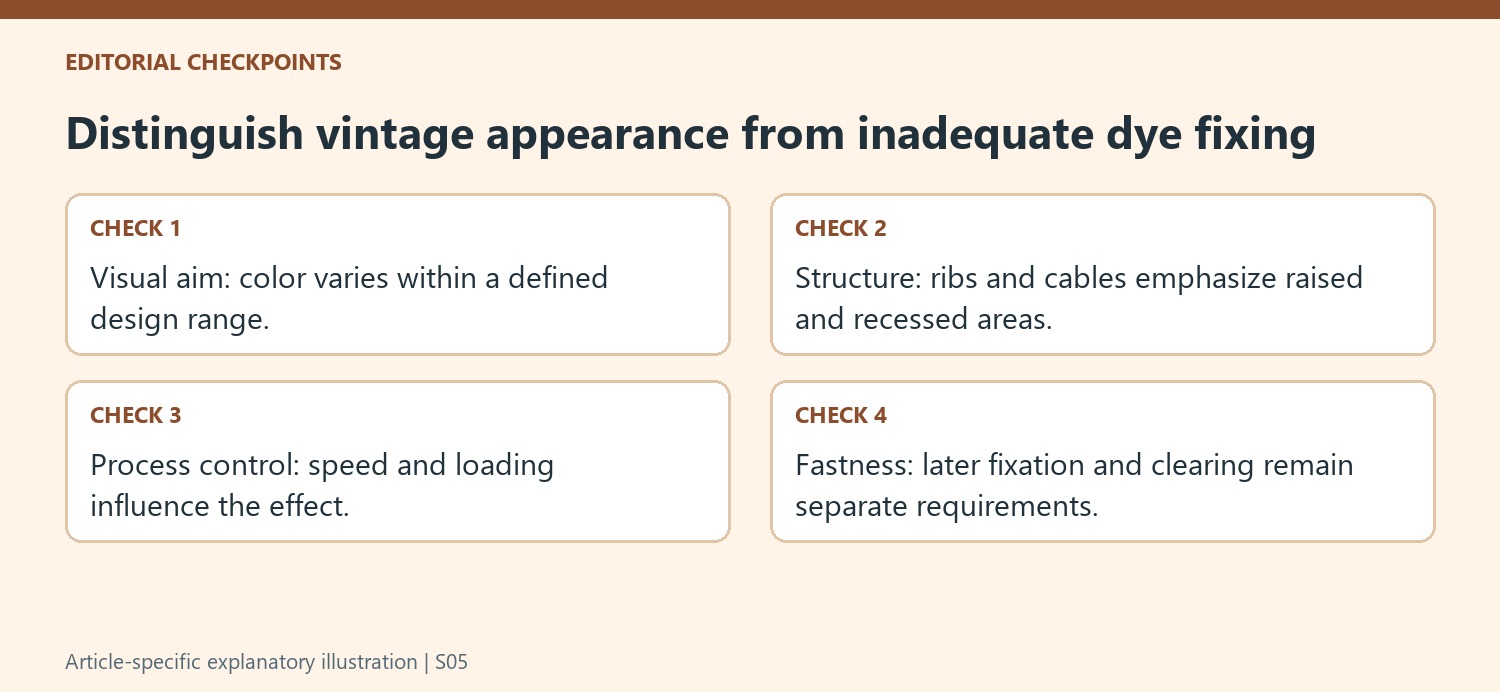
The Merino Vintage Knits guide explains a deliberate departure from completely level color. Woolmark describes uneven uptake that favors more accessible areas associated with lower yarn twist or fabric density. This creates a washed appearance within a planned range rather than relying on uncontrolled wear over time. The visual variation is therefore part of the manufacturing aim. It should not be confused with a requirement that color rub off onto other items or disappear during ordinary laundering. The source explicitly discusses fixing and clearing the dye afterward, showing that the desired appearance and the desired colorfastness are separate targets within one production route.
Dye application and fixation are different stages
The technical account describes faster exhaustion of reactive dyes onto appropriately prepared Merino knitwear, using a particular combination of acidity, temperature and timing. These are factory process conditions, not a home recipe for fading an existing sweater. Once the dye has been taken up, the guide calls for normal fixation and an appropriate clearing cycle. That sequence helps explain how an uneven-looking garment can still be designed to achieve ordinary washing and rubbing fastness. Omitting the later stages would miss the central distinction between a controlled visual effect and inadequately fixed color. A consumer should follow the garment's care instructions rather than attempting to reproduce the industrial process from an abbreviated description.
Texture and loading influence the final appearance
Woolmark identifies ribs and cables as especially suitable structures because raised and recessed areas give the effect a visible setting. It also notes that processing speed and machine loading help distribute the intended effect across a garment. These details connect appearance with both fabric structure and production control. Two pieces can belong to the same defined vintage range without being visually identical at every point. When comparing a product with its catalog image, look for the described range of variation and the overall placement of the effect. A faded style is a deliberate design choice, but it is still useful to distinguish intended variation from a new localized stain or later damage. The fabric's texture and the supplier's description provide context for making that assessment.
References
- Merino Vintage Knits. The Woolmark Company; The Woolmark Company.



Comments
0