 FabricKnowledge Lab

Preparation controls where the dye travels
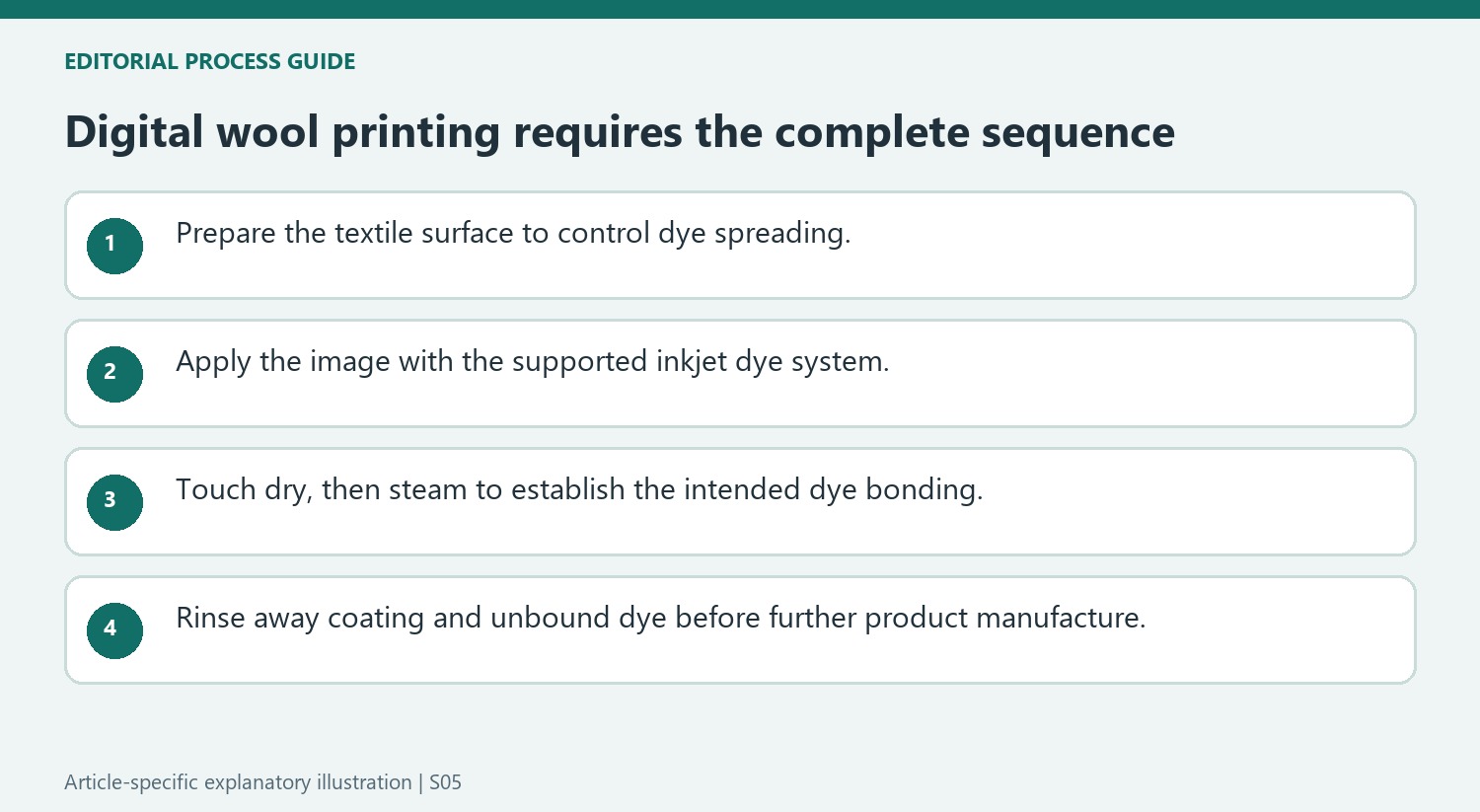
Digital printing applies small amounts of dye in varying concentrations to produce an image on prepared wool fabric. Woolmark describes an initial coating containing seaweed thickener, urea, salt, and citric acid. Its purpose is to control the water-soluble dye so the image does not spread into a blurred smudge. This first stage explains why the process is more than directing an ordinary inkjet image at untreated cloth. The surface preparation and the dye system must work together before the visible pattern can be produced reliably.
Printing and touch drying are intermediate stages
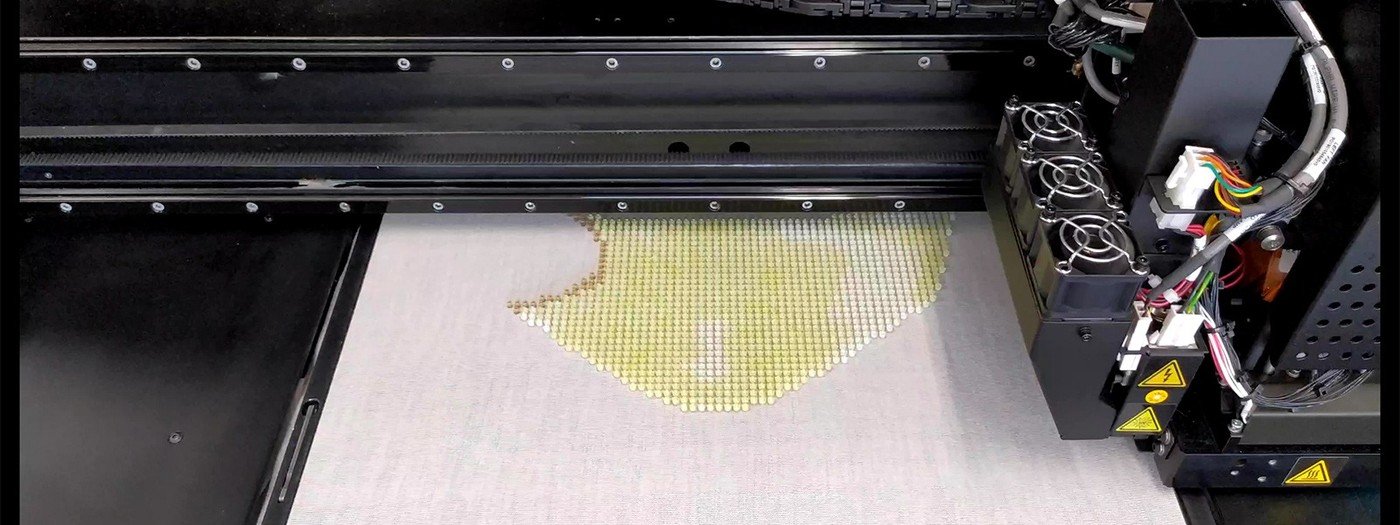
The source describes eight color heads placing very small drops while the fabric is held steady on the printer's belt. Combining the base colors allows detailed patterns and many color variations without changing a physical printing screen for each design. After printing, a heat plate makes the surface touch dry, but the dye initially remains near the top of the textile. That dry appearance should not be confused with completion. Additional processing is needed to move and fix the color appropriately within the wool fiber structure.

Steaming and rinsing complete the sequence
Steaming opens a pathway for the dyes to move from the fabric surface into and around the fibers and form bonds. The preparation coating and excess unbound dye are then washed out so they do not remain available to run later. Woolmark describes applications including garments, scarves, curtains, upholstery, and cushions, with the original fabric feel intended to remain. The sequence shows why visual detail and usable colorfastness are separate requirements. A successful printed sample needs the full preparation and finishing route, not merely a sharp image immediately after it leaves the printer heads.
The preparation coating is temporary process equipment
The coating described by Woolmark is not presented as the final decorative layer. It controls where the water-soluble dye can travel while the image is being applied. Thickener, pH buffering and the other components support a sharp pattern before fixation has occurred. That makes preparation part of printing quality even though the coating is later removed. A sample viewed immediately after printing demonstrates image placement, but it has not yet demonstrated the complete finished textile. The full production route has to establish that the design survives the subsequent stages and that excess process material is washed away. This is a useful distinction when evaluating a decorative technology from a photograph of the printer alone.
Eight base color channels do not mean eight finished colors
The guide describes eight color heads applying very small drops in varying concentrations. Combining these inputs permits many visual colors and tonal transitions, rather than restricting a print to eight solid regions. That is one reason digital printing supports intricate images and design changes without treating each final shade as a separate yarn color. The actual result still depends on the prepared fabric, the chosen dye system and the finishing route. Consider how the design appears across the textile's existing surface instead of judging only a digital image on a screen. The print is being made on wool fabric, whose texture and construction remain part of the visible product.
Fixation and rinsing answer different completion questions
Touch drying addresses the immediate surface condition after printing. Steaming then provides conditions for the dye to move and form the intended bonds, while rinsing removes coating and unbound material afterward. Each stage solves a different problem, so a dry-looking print is not evidence that every stage has been completed. Woolmark names apparel and household applications because the finished decorated cloth can enter several product routes. That flexibility does not mean every printed wool is interchangeable for curtains, upholstery or scarves. The base fabric and its performance still have to suit the chosen use. Ask for the actual finished specification, including relevant colorfastness and care information, rather than treating the ability to print a detailed image as proof of suitability for every end product.
References
- Digital Printing. The Woolmark Company.






Comments
0