 FabricKnowledge Lab
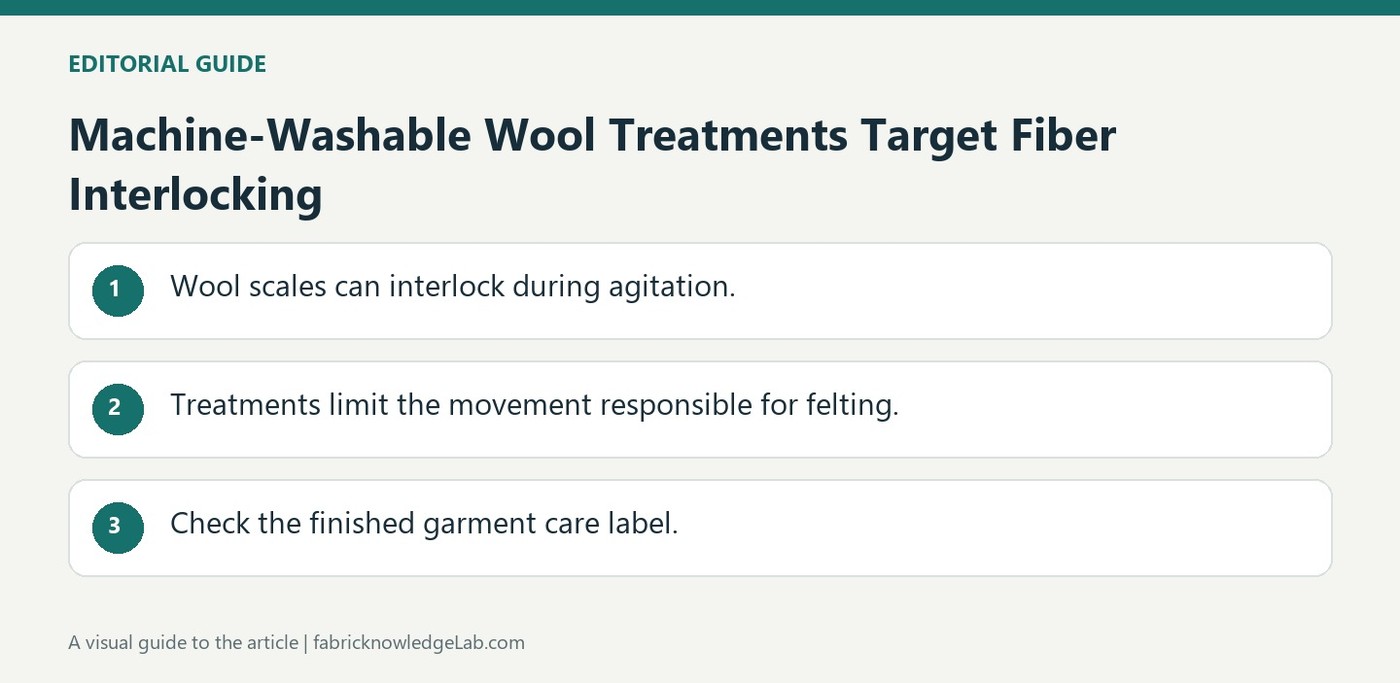
Felting begins with the fiber surface
Untreated wool has microscopic surface scales. Woolmark explains that moisture, heat, and mechanical agitation can allow neighboring fibers to lock together in a ratchet-like action. The resulting entanglement makes the fabric denser and can shrink or distort a garment. This explains why ordinary laundry motion matters alongside temperature. A wash setting that seems mild for a different fiber can still expose untreated wool to an unsuitable combination of conditions. Once felting has occurred, it should not be confused with a temporary wrinkle that can simply be pressed away.
Shrink-resist processes reduce that interaction
Machine-washable wool has undergone treatment or processing intended to reduce excessive felting and dimensional change. Woolmark describes approaches that smooth or modify scales, reduce friction between fibers, or combine both methods. It identifies Hercosett as an established system involving a pretreatment followed by a bonded polymer application. The page also discusses newer chlorine-free alternatives. These are different industrial routes toward a performance requirement; the broad superwash term does not identify one identical chemistry used by every supplier or every product carrying a washable-wool description.
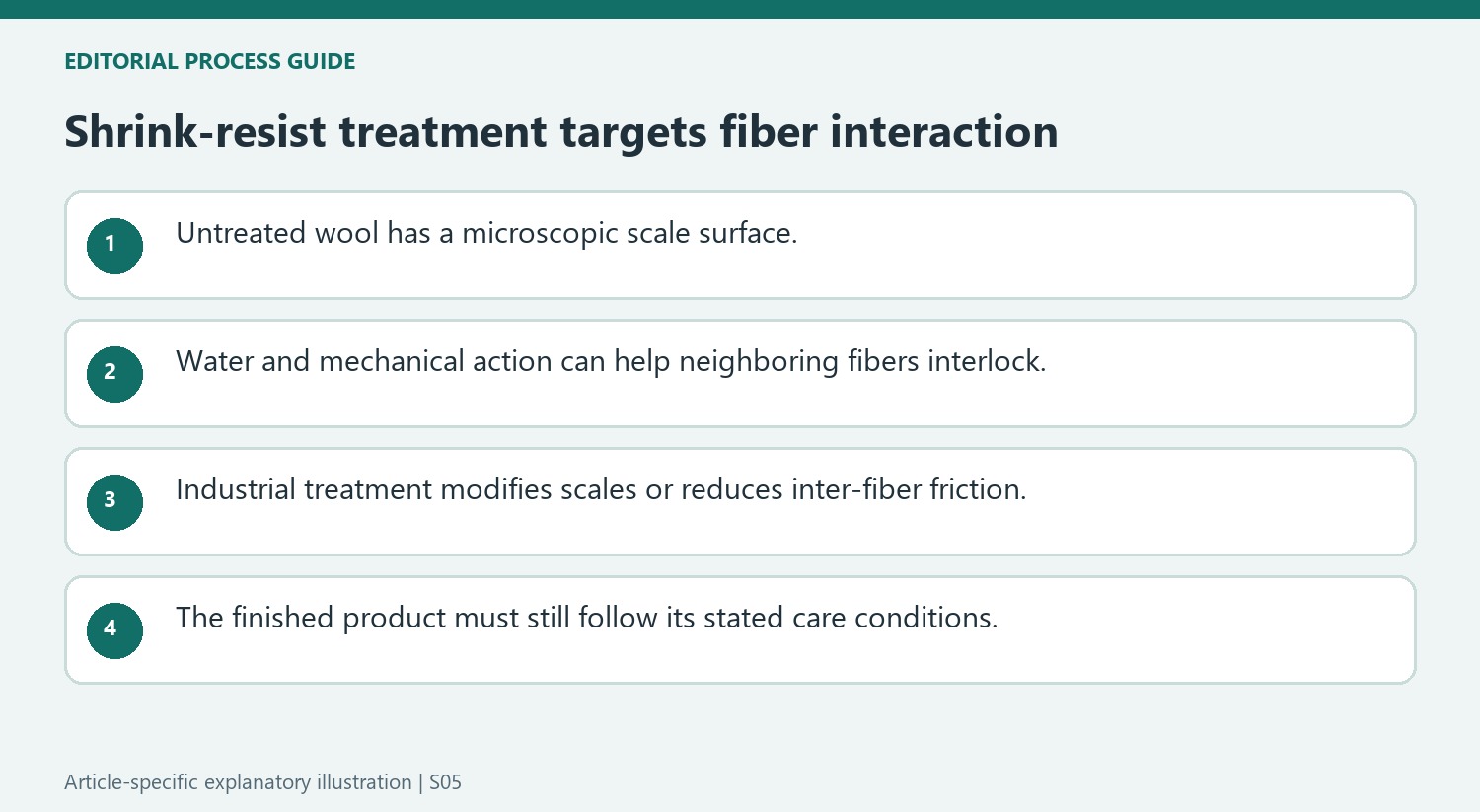
A treatment claim still needs garment instructions
Woolmark associates shrink-resist wool with knitwear, socks, base layers, and other garments where easier laundering is useful. It emphasizes maintaining wool's familiar comfort properties while improving wash performance. The practical conclusion is specific: some wool textiles are engineered for machine care, but that treatment should not be assumed for an unmarked garment. Read the finished item's label for the permitted cycle, temperature, detergent, and drying method. Also distinguish a washability claim from a complete environmental assessment, since the source notes that impacts depend on chemistry, process control, and wastewater management rather than the treatment name alone.
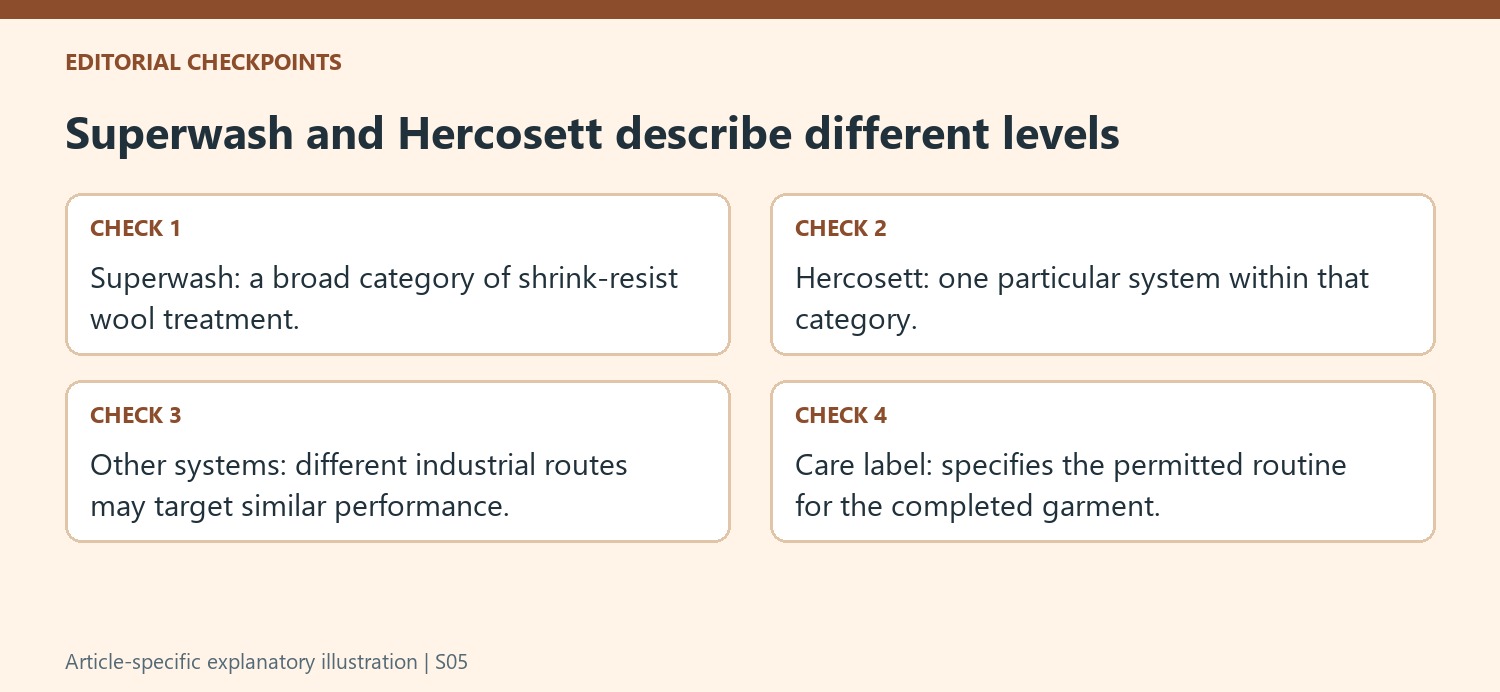
Superwash is a category rather than one chemical recipe
Woolmark explicitly distinguishes the broad superwash designation from Hercosett, a particular shrink-resist system. This matters when comparing suppliers because a shared performance description does not establish an identical treatment chemistry. The guide includes surface modification and friction reduction as approaches to limiting felting. It also discusses chlorine-free developments alongside an established process. A meaningful technical comparison identifies the actual route and the performance required of the finished wool product. A consumer label may not supply every process detail, but its washing instructions still need to be followed. The category explains the intended behavior without licensing assumptions about every material or manufacturing step used to achieve it.
The established system has more than one stage
The source describes Hercosett as a pretreatment that modifies the fiber surface followed by application of a polymer that bonds there. These stages target interactions between neighboring fibers rather than changing wool into a completely different underlying fiber. Their purpose is to reduce the interlocking that can produce felting under laundry conditions. This does not mean untreated wool can be made equivalent by choosing a different detergent at home. The industrial treatment precedes the consumer's wash routine. Once a garment is made, the user works within its documented care conditions rather than attempting to reproduce the manufacturing process. The distinction is important because ordinary cleaning and engineered shrink resistance address different parts of the product's life.
Dimensional stability still belongs to the complete garment
The guide associates shrink-resist treatment with improved dimensional stability over repeated washing, but a garment is more than an isolated fiber. Its knitted or woven structure, seams and other components remain part of the item whose label specifies care. A permitted machine wash should therefore be read together with temperature, cycle and drying instructions. It is not a blanket statement that every laundry program is suitable. Environmental comparisons also need a defined scope. Woolmark discusses chemistry, process control and wastewater management, which makes the treatment name alone an incomplete assessment. Keep evidence about the factory process separate from the practical advantage of easier laundering. Both may be relevant, but they answer different questions about how the particular wool product is made and used.
References
- Machine Washable Wool. The Woolmark Company.



Comments
0